
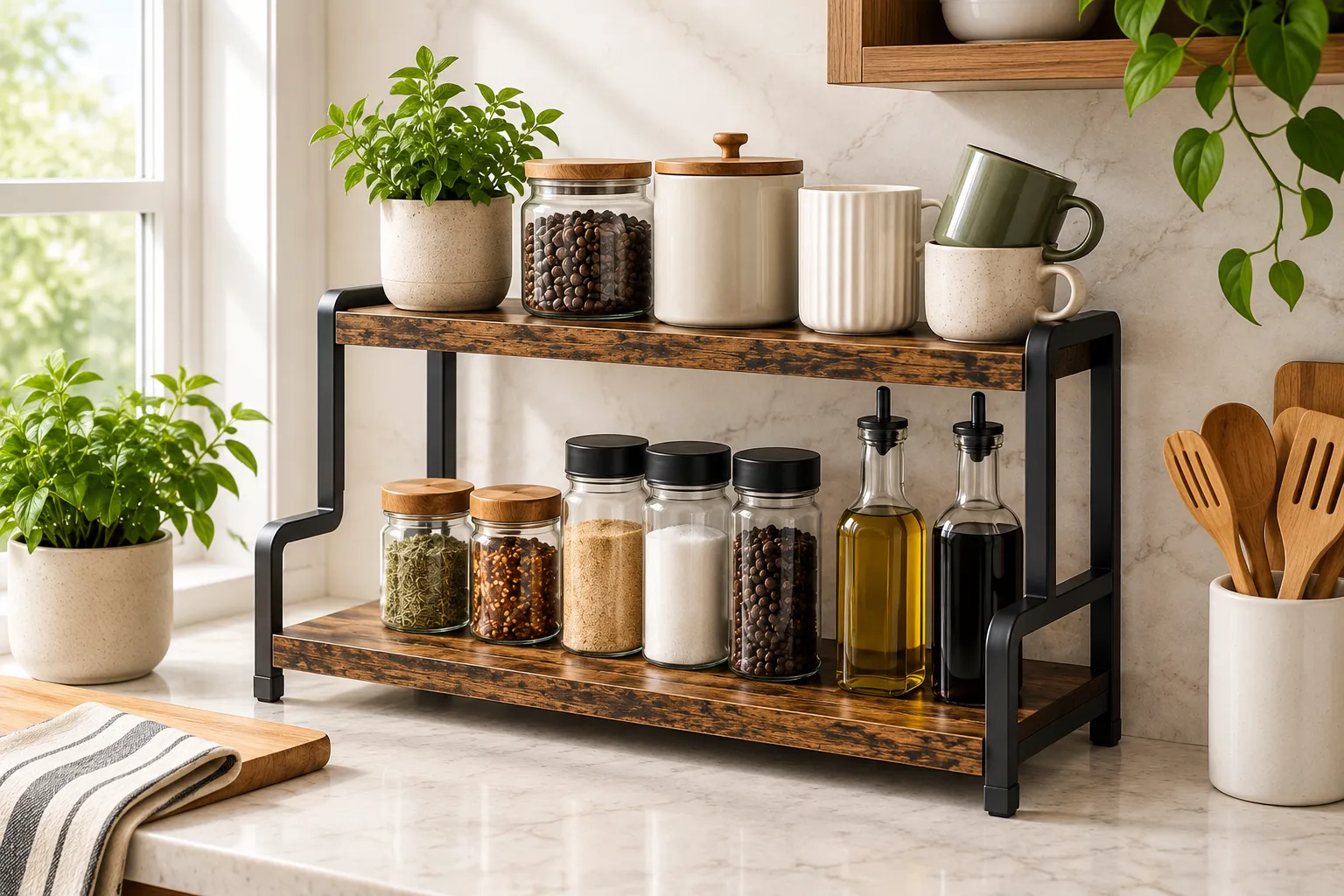
A 2-tier countertop organizer can be useful when your kitchen needs one extra level of storage—but not enough storage to justify a tall shelf taking over the counter.
That distinction matters.
Two-tier storage works best when you want to keep a small group of frequently used items together while preserving easy access and enough open space beneath your upper cabinets.
Before buying one, focus less on how the organizer looks in the product photo and more on four things:
its footprint, total height, space between the tiers and what you actually plan to store on it.
Here’s how to choose one that works in a real kitchen.
1. Decide Whether Two Tiers Are Actually Enough
Start with the items you want to organize.
Put them together temporarily.
Maybe that’s:
- four mugs
- coffee or tea
- sugar
- two or three small jars
Or:
- a few seasonings
- one bottle
- everyday cooking ingredients
If those items can comfortably fit across two levels, a 2-tier organizer may be enough.
Don’t automatically choose the organizer with the most shelves.
More storage isn’t always better.
A taller unit can reduce visibility, create tighter shelf spacing and make the countertop feel heavier.
A 2-tier design works particularly well when you want one additional storage surface without building too high.
2. Measure the Countertop Footprint First
Measure the exact section of counter where the organizer will sit.
Record:
Width × Depth
Then compare those measurements with the organizer’s overall footprint.
Don’t forget the space around it.
You may need room for:
- an appliance door
- a cabinet drawer
- an electrical outlet
- a kettle
- a coffee maker
- your actual food-preparation area
An organizer technically fitting the counter doesn’t automatically mean it belongs there.
It should leave enough room for the counter to remain usable.
If you’re regularly buying organizers before checking the available space, our guide on how to measure kitchen storage for organizers goes deeper into usable width, depth, height and obstructions.
3. Check the Upper-Cabinet Clearance
This measurement is especially important for countertop shelves.
Measure from the countertop to the underside of the cabinet above it.
Then compare that with the total height of the organizer.
Don’t aim for a fit so tight that:
- items are difficult to remove
- the top shelf is unusable
- you can’t clean around it
- tall containers hit the cabinet
You need usable clearance—not simply enough room for the frame to stand there.
4. Measure the Space Between the Two Tiers
The outside dimensions tell you whether the organizer fits your kitchen.
The shelf spacing tells you whether your belongings fit the organizer.
Measure the items you plan to store.
For example:
Mug height: ___
Coffee jar: ___
Oil bottle: ___
Storage canister: ___
Then check the usable vertical space between the lower and upper shelf.
This is one of the most important checks for a 2-tier design.
A shelf can fit beautifully beneath your cabinet and still be useless if your everyday containers don’t fit between its two levels.
5. Think About What Belongs on the Top vs Bottom
Don’t fill the organizer randomly.
Use the two levels differently.
Lower tier
Best for items that are:
- heavier
- taller if clearance allows
- frequently removed
- more stable near the counter
Upper tier
Often better for:
- lighter containers
- smaller jars
- mugs
- frequently visible items
Keeping heavier items lower can also help the setup feel more stable.
Always follow the product manufacturer’s weight and use guidance.
6. Check Whether Items Are Easy to Remove
A well-organized shelf shouldn’t require moving three things to reach one.
Test the idea before buying.
Imagine a mug on the lower shelf.
Can you lift it straight out?
Would a jar have enough room to clear the shelf above?
Would bottles need to tilt awkwardly?
This matters more than how many items can technically fit.
Good organization reduces friction.
If a shelf creates another puzzle every time you make coffee, it isn’t helping.
7. A 2-Tier Organizer Works Best for a Small, Defined Zone
This article used to spend separate sections on coffee supplies, spices, oils, jars and pantry goods. Those uses are possible, but they don’t need individual sections.
A better principle is:
choose one purpose for the organizer.
For example:
Coffee zone
Mugs + coffee + sugar.
Cooking zone
Frequently used seasonings + a few cooking essentials.
Breakfast zone
Oats + spreads + frequently used breakfast items.
A defined zone is easier to maintain than a shelf that becomes the home for everything that doesn’t fit elsewhere.
8. Don’t Use the Extra Shelf as Permission to Keep More Clutter
Adding another level gives you more storage.
That doesn’t mean you need to fill every centimetre of it.
Before putting something on the organizer, ask:
Do I use this often enough to deserve countertop space?
Occasional items may be better inside a cupboard or pantry.
Your broader small kitchen organization ideas guide explains why the easiest-to-reach areas should be reserved for frequently used items rather than low-use equipment.
9. When a 2-Tier Organizer Is Better Than a 3-Tier One
A 2-tier design can be the better choice when:
- upper cabinets limit your height
- you mainly store mugs or medium-height containers
- you want less visual bulk
- the counter is already narrow
- you need easy access from above
- you only need one extra level
A 3-tier unit may make more sense when vertical clearance is generous and you genuinely need three accessible storage levels.
We’ll make your separate 3-tier countertop organizer article focus specifically on those situations, including shelf height, stability, accessibility and weight distribution.
That distinction is exactly what will stop the two pages from competing with each other.
10. Check Stability Before Loading It
Countertop organizers need to remain stable during everyday use.
Before loading one heavily, check:
- how the frame sits on the counter
- whether the shelves feel level
- whether any adjustable feet are properly set
- whether the manufacturer specifies a weight limit
- whether pulling one item makes the unit move
Avoid guessing at weight capacity.
Use the manufacturer’s specifications for the particular organizer you’re considering.
And distribute items sensibly rather than putting every heavy container on one side.
11. Make Sure You Can Clean Around It
A countertop organizer should not turn cleaning into a bigger job.
Think about:
Can I wipe underneath it?
Can the whole unit be moved if necessary?
Will spills collect around the feet?
Are the shelf surfaces easy to wipe?
The best countertop system should make the space easier to maintain, not simply hide more objects above it.
12. Know When You Need a Different Storage Solution
A 2-tier shelf isn’t always the answer.
Consider another solution if:
- your items are too tall for the shelves
- the counter is needed for food preparation
- upper cabinets leave very little clearance
- you need three or more levels
- most of the items could live inside a cabinet
- you’re trying to store too many unrelated categories
Your broader small kitchen countertop storage ideas article will become the better resource for comparing multiple storage options—not just tiered organizers.
Is a 2-Tier Countertop Organizer Right for Your Kitchen?
A 2-tier organizer is most useful when you need a little more vertical storage without adding too much height.
Before buying one:
measure the footprint,
check cabinet clearance,
measure the space between tiers,
measure the items themselves,
and decide exactly what category will live there.
Then ask one final question:
Will this make the counter easier to use?
If the answer is yes, two tiers may be all you need.
Frequently Asked Questions
What should I measure before buying a 2-tier countertop organizer?
Measure the available countertop width and depth, the clearance beneath upper cabinets, and the items you plan to store. Also check the usable space between the two shelves.
What is a 2-tier countertop organizer best for?
It works best for a small, defined category of frequently used kitchen items where you need one additional level of storage without adding too much overall height.
Is a 2-tier or 3-tier countertop organizer better?
It depends on your available height and storage needs. A 2-tier organizer offers easier access and a lower profile, while three tiers can provide more storage when vertical clearance allows.
Can a 2-tier organizer fit under kitchen cabinets?
Many can, but dimensions vary. Measure the countertop-to-cabinet clearance and compare it with the organizer's total height before purchasing.
Should heavy items go on the top or bottom shelf?
Heavier items are generally more sensible on the lower level, but always follow the specific product's weight and safety guidance.
Join the conversation.