
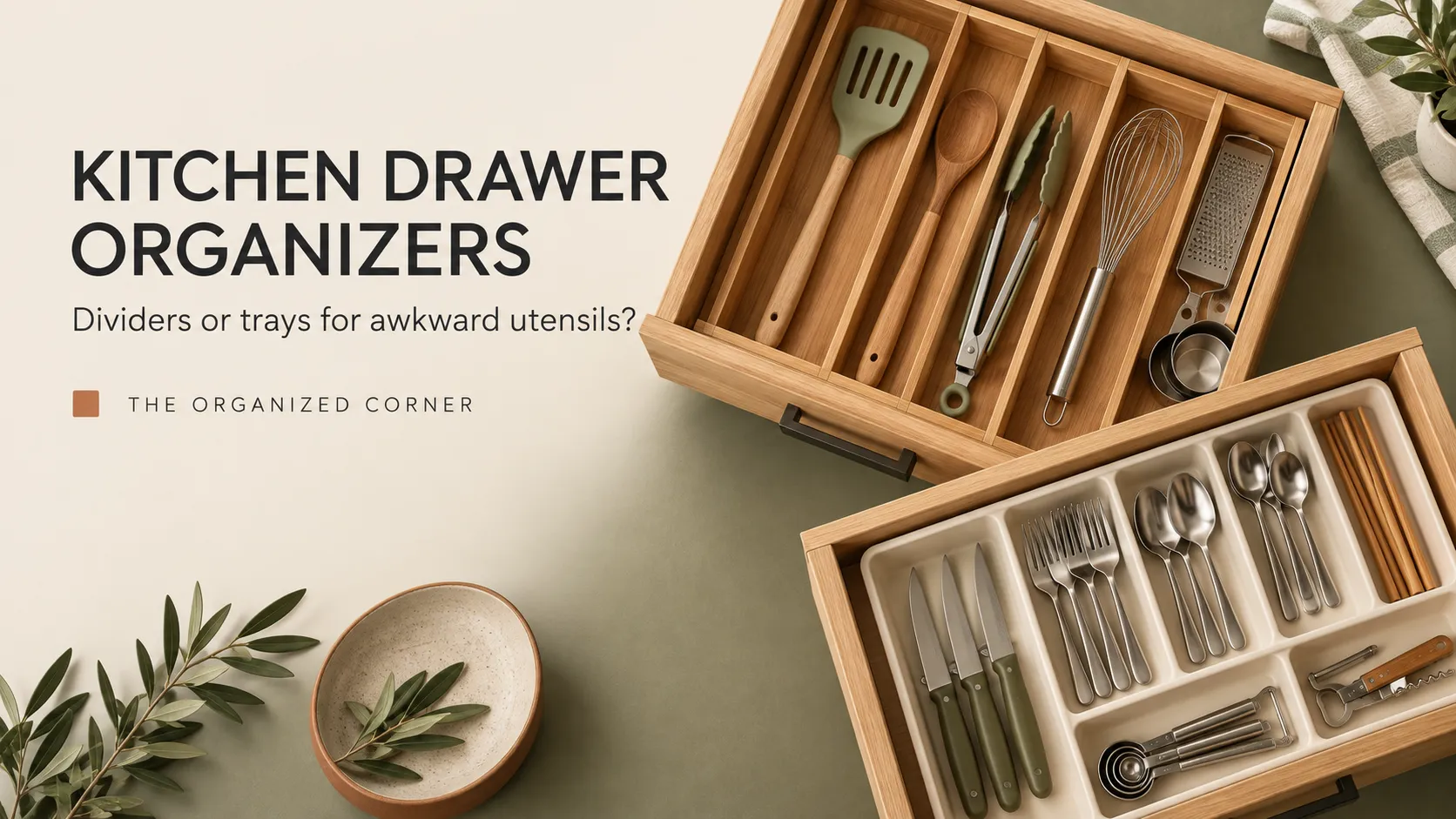
Some kitchen utensils are easy to organize. Forks, spoons and table knives fit comfortably into standard compartments.
The awkward items are another story.
Long spatulas overlap. Whisks catch against other tools. Measuring spoons disappear beneath larger utensils, and small gadgets slide into whatever space is available.
The problem isn’t always the size of the drawer. Sometimes it’s the type of organizer you’re using.
When choosing kitchen drawer dividers vs trays, the important question is whether your utensils need flexible boundaries or individual compartments.
Here’s how to decide.
1. Start With the Utensils That Never Fit Properly
Before buying an organizer, empty the drawer and group the contents by shape and use.
Separate items into a few practical categories:
- Long tools, such as spatulas, tongs and whisks
- Small gadgets, such as peelers and bottle openers
- Measuring spoons and small accessories
- Everyday cutlery
- Tools you rarely use
Notice which items create the biggest problem.
If long utensils overlap constantly, you may need wider, longer sections. If small gadgets disappear into gaps, individual compartments may be more useful.
Organize around the items you own, not the compartments in a product photograph.
2. When Drawer Dividers Work Best
Dividers create boundaries within an existing drawer. Depending on their design, they can separate long utensils, cooking tools or broader categories without requiring a dedicated tray for each item.
They are particularly useful when:
- Your utensils vary in length.
- You want to adjust the size of each section.
- Several long tools need to sit together.
- Your collection changes occasionally.
For example, you could create one long section for spatulas and tongs, another for whisks, and a smaller area for frequently used gadgets.
The main advantage is flexibility: the storage zones can be arranged around your utensils rather than forcing every item into a predetermined compartment.
3. When Separate Trays Make More Sense
Trays are useful when you want individual, clearly defined compartments.
A modular set with different tray sizes can help separate small gadgets, measuring tools, clips and other items that tend to mix together.
Trays may suit your drawer better when:
- You store many small objects.
- Different categories need their own compartments.
- You want to lift out a section for cleaning.
- Your drawer benefits from several separate container sizes.
The limitation is that fixed trays may leave awkward gaps if their dimensions don’t match your drawer. Too many small compartments can also make long utensils difficult to accommodate.
You don’t necessarily need to choose one approach for the entire drawer. A divider for long tools and a small tray for loose accessories can work well together.
4. Measure the Drawer Before You Buy
Both options need to fit the drawer’s usable space.
Measure the internal width, depth and height, rather than the outside dimensions of the cabinet.
Also check whether the organizer will allow the drawer to close comfortably when the utensils are inside.
For dividers, check the required installation width and adjustment range. For trays, compare the individual tray dimensions with your available space and consider how the pieces will fit together.
Our guide on how to measure kitchen cabinets for organizers explains how to check usable dimensions before buying storage products.
5. Give the Awkward Items Their Own Spaces
Once you’ve chosen the organizer, focus on the items that were causing the most frustration.
Long tools should have enough room to lie flat without catching against other compartments. Small gadgets should have a defined section where they won’t disappear underneath larger utensils.
Keep the items you use most often easy to reach, and avoid filling every compartment to its limit.
If a tool doesn’t fit comfortably, don’t force it into the drawer just because there’s technically room. It may belong in a different drawer or storage area.
For more ways to make a compact kitchen easier to use, see our guide to small kitchen organization ideas.
Which Kitchen Drawer Organizer Should You Choose?
Choose dividers when you need flexible sections for long or differently sized utensils.
Choose trays when smaller gadgets and accessories keep mixing together and need separate compartments.
Use both when the drawer contains a combination of long tools and small items.
The best setup isn’t necessarily the most elaborate one. It’s the one that makes your utensils easy to find, easy to remove and easy to put back.
Frequently Asked Questions
Are kitchen drawer dividers better than trays?
Dividers are useful for creating flexible sections, especially for long tools. Trays work well for separating small gadgets and accessories into individual compartments.
Can I use dividers and trays in the same drawer?
Yes. You can use a long section for spatulas and tongs, then place a smaller tray in the remaining space for measuring spoons or loose gadgets.
How do I organize awkward kitchen utensils?
Group tools by shape and use, measure the drawer, and choose compartments that accommodate the longest and most awkward items first. Store frequently used tools where they're easy to reach.
Should I measure my drawer before buying an organizer?
Yes. Measure the internal width, depth and height, and compare those measurements with the organizer's actual dimensions and installation requirements.

Join the conversation.