
A kitchen organizer can look perfect online.
Then it arrives and is half an inch too wide, too deep for the cabinet door to close, or tall enough to hit the shelf above it.
That’s why the most useful step often happens before you buy anything.
Learning how to measure kitchen cabinets for organizers helps you understand the space you actually have—not the dimensions the cabinet appears to have from the outside.
And the important word is usable.
Hinges, pipes, shelf supports, drawer sides and narrow openings can all reduce the amount of space an organizer can realistically occupy.
What Measurements Do You Need for a Cabinet Organizer?
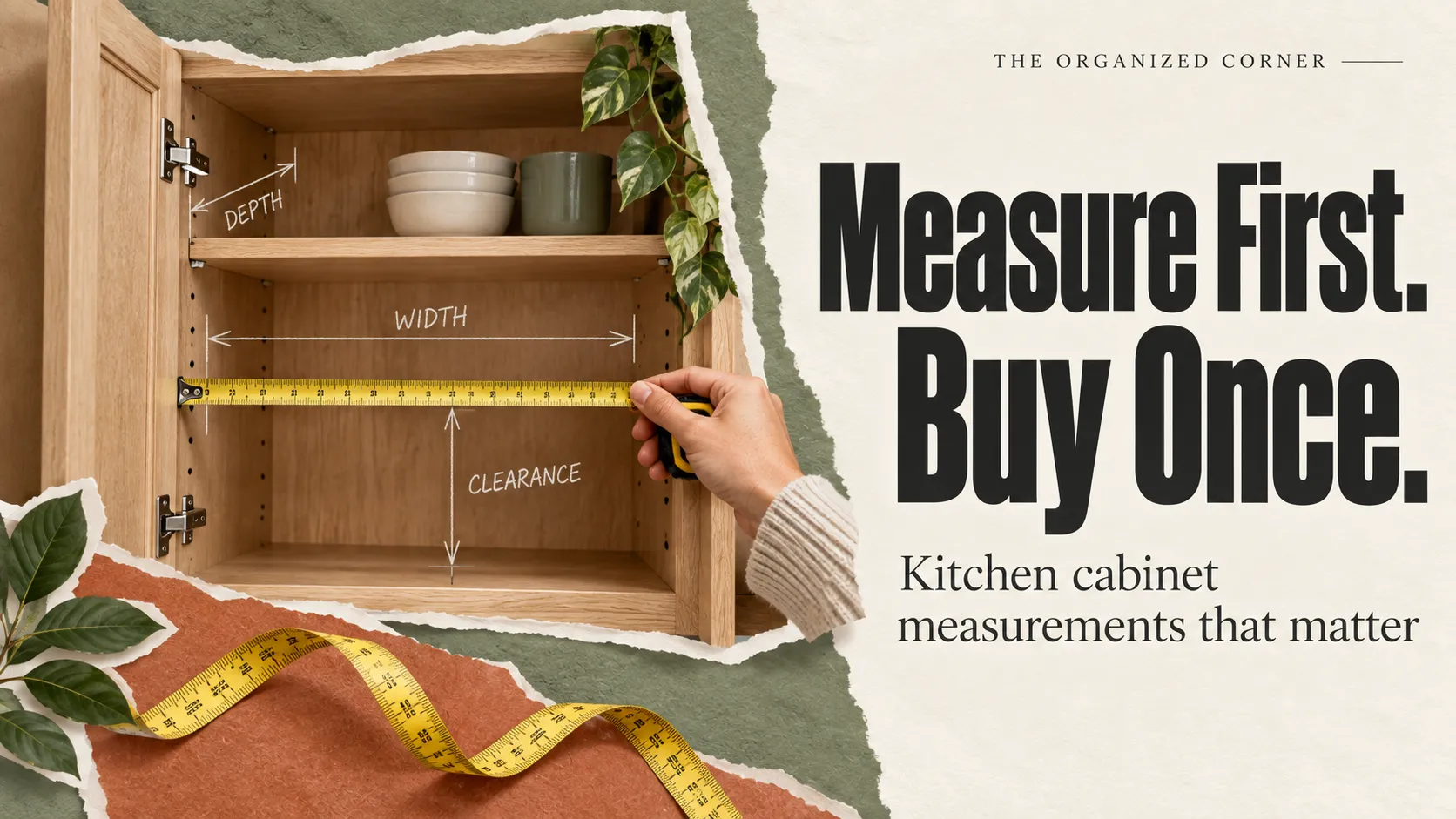
Before buying a kitchen cabinet organizer, record five things:
Width: the narrowest usable side-to-side measurement
Depth: the usable space from front to back
Height: the available vertical clearance
Clear opening: the narrowest space the organizer must pass through
Obstructions: hinges, pipes, shelf supports, frames or hardware that reduce usable space
Record cabinet dimensions as W × D × H, then compare your measurements with the organizer manufacturer’s actual product dimensions and required clearance.
1. Measure the Inside, Not the Outside
The exterior width of a kitchen cabinet doesn’t tell you how much usable storage space is inside.
Open the cabinet and measure the actual interior.
For most organizers, record:
Width — side to side
Depth — front to back
Height — bottom to top
Write them in the same order each time:
W × D × H
Keeping your measurements consistent makes comparing them with product specifications much easier.
2. Measure the Clear Opening Too
This is one of the measurements people often forget.
A cabinet may be wide inside but have a narrower opening because of:
- door frames
- hinges
- centre dividers
- face frames
- hardware
If an organizer cannot physically pass through the opening, the larger interior measurement doesn’t help.
Measure the narrowest usable opening from side to side.
For tall organizers, check the opening height as well.
3. Check Width in More Than One Place
Don’t automatically assume the cabinet is exactly the same width from front to back.
Take a width measurement near the:
- front
- middle
- back
If the numbers vary slightly, use the smallest usable measurement when checking whether an organizer will fit.
That gives you a safer working dimension.
4. Measure the Usable Depth
Measure from the usable front edge of the cabinet to the back wall.
Then check whether anything reduces that depth.
Look for:
- door hardware
- hinges
- pipes
- cables
- shelf supports
- cabinet lips
- unusual back panels
Also consider whether the organizer itself needs space to slide, rotate or be removed.
A product that technically fits the depth measurement may still be awkward to use if it has no room to move.
5. Measure Vertical Clearance
Height matters especially when you’re using:
- stackable shelves
- tiered organizers
- tall containers
- pan racks
- pull-out storage
- shelf risers
Measure the available height where the organizer will actually sit.
If your cabinet has adjustable shelves, consider whether moving a shelf would create a better layout before buying another storage product.
Sometimes rearranging what you already have solves the problem.
6. Account for Cabinet Doors and Hinges
An organizer doesn’t only need to fit inside the cabinet.
You also need to be able to use it comfortably.
Open and close the cabinet door while looking at the area you’re measuring.
Ask:
Does the hinge enter this space?
Does the door narrow the opening?
Will I still be able to pull the organizer forward?
This is especially important for pull-out baskets and wider storage bins.
7. Measure Drawers Separately
Don’t use the cabinet dimensions for a drawer organizer.
Remove or open the drawer fully and measure its actual internal:
- width
- depth
- height
Also check anything that reduces usable space.
For expandable organizers, compare your drawer width with the product’s minimum and maximum expansion range.
Your existing guide to an expandable kitchen drawer organizer also explains why internal width, depth and height matter when choosing drawer storage.
8. Be Extra Careful Under the Sink
Under-sink cabinets often look spacious until you account for everything inside them.
Measure around:
- water pipes
- drain pipes
- disposal units
- filters
- hoses
- cabinet hinges
Don’t simply record the overall cabinet width.
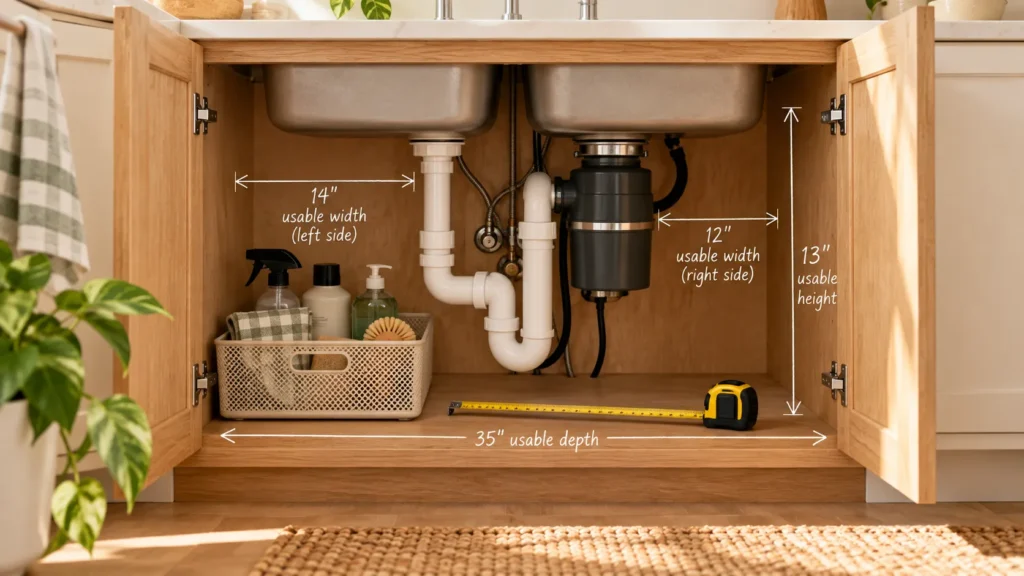
You may have one large cabinet but several smaller usable storage zones.
Sketching the cabinet can help here.
For example:
Left side: narrow but full height
Centre: blocked by plumbing
Right side: suitable for a pull-out basket
That makes product shopping much more accurate.
9. Measure What You Want to Store Too
The cabinet isn’t the only thing that matters.
Measure tall bottles, pans, containers or appliances you plan to put inside the organizer.
For example, a shelf riser may fit perfectly inside the cabinet but leave too little clearance underneath for the bowls you wanted to store there.
You need to know:
Does the organizer fit?
and
Do the items fit once the organizer is inside?
Both matter.
10. Compare Your Measurements With the Product’s Actual Dimensions
Before ordering, check the seller’s listed dimensions carefully.
Look for:
- overall width
- overall depth
- overall height
- internal compartment sizes
- expansion range
- required installation clearance
Don’t rely only on product photographs.
Images can make an organizer appear much smaller or larger than it really is.
Your actual cabinet measurements should make the decision.
11. Don’t Buy an Organizer Just Because It Fits
Fit is only the first test.
Also ask:
Will it make the contents easier to reach?
Will it make putting things away simpler?
Does this category actually need an organizer?
Could moving fewer items here solve the problem instead?
Your broader small kitchen organization ideas guide explains why good storage should reduce effort rather than simply squeeze more things into the same cabinet.
A perfectly fitting organizer that makes everyday items harder to use isn’t an improvement.
12. Keep a Measurement Record
Once you’ve measured a cabinet, don’t make yourself do it again next month.
Keep a simple note containing:
Cabinet: lower cabinet beside stove
Width: ___
Depth: ___
Height: ___
Clear opening: ___
Obstructions: right hinge / pipe / shelf support
Items stored: pans and lids
Do the same for drawers and shelves as needed.
That gives you a reference you can take with you when shopping online or in-store.
Measure First. Then Decide What You Actually Need.
Kitchen storage becomes much easier when you stop guessing.
Measure the actual usable width.
Check the depth.
Record the height.
Measure the clear opening.
Notice hinges, pipes and other obstructions.
Then compare those dimensions with both the organizer and the items you plan to store inside it.
That small amount of preparation can save you from buying storage that doesn’t fit—or buying storage you didn’t really need in the first place.
Frequently Asked Questions
How do I measure a kitchen cabinet for an organizer?
Measure the usable interior width, depth and height, then measure the clear opening and note anything such as hinges, pipes or shelf supports that reduces the usable space.
Should I measure the inside or outside of a kitchen cabinet?
For storage organizers, use the actual usable interior measurements and clear opening rather than relying on the cabinet's outside dimensions.
What measurements do I need for a drawer organizer?
Measure the drawer's internal width, depth and height. For expandable organizers, also compare your drawer width with the organizer's stated expansion range.
Should an organizer be exactly the same size as the cabinet?
Usually you should follow the manufacturer's required dimensions and installation clearance rather than assuming an exact fit is ideal. Some organizers need room for movement, installation or removal.

Join the conversation.