
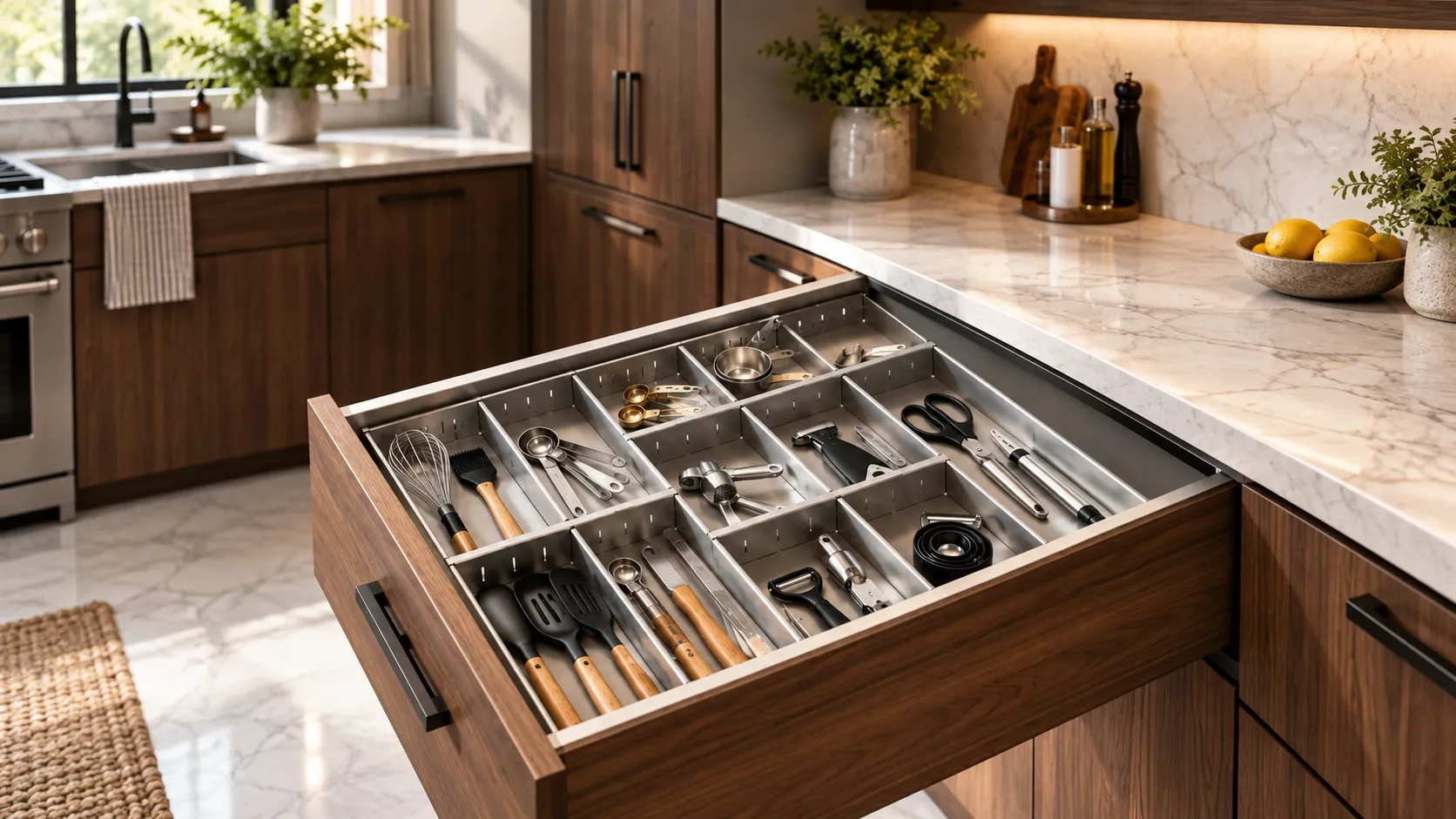
A kitchen drawer can become messy surprisingly fast.
Measuring spoons slide underneath spatulas. Peelers disappear beneath utensils. Scissors get buried under gadgets. Small tools end up scattered across the drawer even if you recently organized everything.
The problem is not always that you have too many kitchen tools.
Sometimes the drawer simply does not have enough defined sections.
An expandable kitchen drawer organizer can divide one large drawer into smaller storage zones so utensils, measuring tools, gadgets, scissors, and everyday cooking essentials each have a clear place.
That can make the drawer easier to use and much easier to keep organized.
Why Kitchen Drawers Become Messy So Quickly
Most kitchen drawers are essentially one large empty space.
Without compartments, every item moves around each time the drawer opens and closes.
Small objects are especially likely to disappear underneath larger utensils.
Common troublemakers include:
- Measuring spoons
- Peelers
- Bottle openers
- Whisks
- Scissors
- Tongs
- Small spatulas
- Cooking gadgets
- Thermometers
- Clips
- Can openers
Even if everything starts neatly arranged, the lack of physical separation allows items to mix together again.
That is why dividers and dedicated compartments can make such a noticeable difference.
How an Expandable Kitchen Drawer Organizer Works
An expandable organizer is designed to adjust to different drawer widths.
Instead of fitting only one fixed size, the organizer can extend to use more of the available space.
This can help reduce gaps around the sides and create more usable storage inside the drawer.
Depending on the design, you may have compartments for:
- Cutlery
- Cooking utensils
- Measuring tools
- Small gadgets
- Scissors
- Peelers
- Bottle openers
- Specialty kitchen tools
The main benefit is structure.
Every category gets its own place.
Start by Emptying the Entire Drawer
Before adding an organizer, remove everything.
This is important because it lets you see how much you actually own and how much space you need.
Place all the items on the counter and group similar things together.
For example:
- Measuring tools
- Cutting tools
- Stirring tools
- Small gadgets
- Serving utensils
This makes it much easier to decide how the organizer should be arranged.
Declutter Before You Organize
Do not simply put everything back.
Use the opportunity to remove items you no longer need.
Look for:
- Duplicate tools
- Broken utensils
- Gadgets you never use
- Damaged peelers
- Extra measuring spoons
- Random items that belong somewhere else
A drawer organizer works best when it is holding useful items rather than simply creating compartments for clutter.
If deciding what to remove feels like the hardest part, our guide on how to start decluttering when overwhelmed can help you work through one small space at a time.
Give Every Tool a Dedicated Space
Once you know what is staying, assign categories.
For example:
Measuring Tools
Keep measuring spoons and small measuring cups together.
Cutting Tools
Store kitchen scissors, peelers, and small cutting gadgets in one section.
Cooking Utensils
Keep spatulas, whisks, and serving tools grouped.
Small Gadgets
Use smaller compartments for bottle openers, clips, or specialty tools.
The exact layout depends on your drawer.
The goal is consistency.
Put Everyday Tools in the Easiest-to-Reach Sections
The items you use most often should be easiest to access.
If you use measuring spoons every day, keep them near the front.
If a specialty tool only gets used once a month, it can sit farther back.
This makes the drawer support your routine instead of simply looking organized.
Use Adjustable Sections to Reduce Wasted Space
Fixed organizers sometimes leave large empty gaps.
An expandable organizer can be more flexible because it can adjust to the drawer.
That can help make better use of the available width.
The organizer should fit securely without making the drawer difficult to open or close.
Always check the current dimensions before purchasing.
Keep Small Tools From Getting Lost
Small kitchen tools are often the hardest things to organize.
They slide underneath larger utensils and disappear into corners.
Dedicated compartments help prevent that.
Items such as measuring spoons, peelers, bottle openers, clips, and small gadgets are easier to find when they have their own section.
This can save time during cooking.
Avoid Overfilling Every Compartment
A common mistake is trying to fit too much into each section.
If compartments are packed tightly, removing one tool can disturb everything around it.
Leave some breathing room.
A slightly less full organizer is usually easier to maintain.
Organize by Function, Not Just Size
It can be tempting to place similar-sized items together.
But organizing by function is often more useful.
For example, measuring spoons and measuring cups belong together even if they are different sizes.
Similarly, peelers, small knives, and scissors may belong in one preparation-tools section.
Think about how you use the kitchen.
That can help you create more logical categories.
Keep Frequently Used Drawers Simple
The drawer you open most often should be the easiest one to understand.
Avoid filling it with rarely used tools.
Everyday utensils and cooking gadgets should have priority.
Specialty tools can go into another drawer or cabinet if space is limited.
This keeps the main drawer focused and practical.
Why Drawer Organization Can Make Cooking Easier
Organization is not just about appearance.
A well-organized kitchen can make everyday tasks quicker.
You do not have to stop and search for a peeler. And you know where the measuring spoons are.
You can grab scissors immediately.
Small improvements like this reduce friction during cooking.
If crowded drawers are only one of the problem areas in your kitchen, these small kitchen organization ideas can help make counters, cabinets, drawers and everyday cooking zones easier to use.
A Cleaner Drawer Is Easier to Maintain
A drawer with dedicated sections is easier to reset.
When every item has a clear location, putting things away becomes almost automatic.
Without compartments, you have to decide where to place each tool every time.
That usually leads to clutter.
A structured drawer removes that decision.
Measure Your Drawer Before Buying an Organizer
Always measure the inside of the drawer.
Check:
- Internal width
- Internal depth
- Internal height
- Available expansion range
Do not rely on the outside dimensions of the cabinet.
Compare your measurements with the current product specifications before ordering.
Check Drawer Height Too
Width and depth are important, but height matters as well.
Some organizers may be too tall for shallow drawers.
Make sure the drawer can close comfortably once the organizer and utensils are inside.
This is especially important for thick-handled tools.
Use Multiple Organizers for Deep Drawers
If you have a large drawer, one organizer may not be enough.
You can combine different storage solutions.
For example:
- Expandable organizer for small utensils
- Divider for long tools
- Small tray for clips or gadgets
The best layout is the one that matches your actual kitchen tools.
Keep Sharp Tools Separate When Appropriate
Avoid mixing sharp objects loosely with everyday utensils.
If knives or sharp gadgets are stored in a drawer, use a storage solution specifically designed to hold them securely.
Keeping sharp items properly separated can also prevent damage to other utensils.
Clean the Drawer Before Reorganizing
Once the drawer is empty, wipe it down.
Remove crumbs, dust, and residue before adding the organizer.
This gives you a cleaner starting point.
It also makes the finished drawer feel more intentional.
Is an Expandable Kitchen Drawer Organizer Worth It?
If your kitchen drawer becomes messy again every time you use it, an organizer can be a practical upgrade.
The main advantage is that it creates physical boundaries between different tools.
Instead of one large pile, you get defined sections.
That can make everyday cooking tools easier to see, easier to grab, and easier to put away.
For a drawer filled with measuring spoons, peelers, scissors, gadgets, and utensils, that structure can be very useful.
A Better Drawer Starts With Better Categories
You do not need a perfectly styled kitchen drawer.
You need one that works.
Remove what you do not use.
Group similar tools.
Give each category a section.
Keep everyday items accessible.
Leave a little empty space.
That simple system can turn a chaotic drawer into one that is much easier to use every day.
Frequently Asked Questions About Kitchen Drawer Organizers
Are Expandable Drawer Organizers Good for Kitchen Utensils?
Yes. They can help separate utensils, measuring tools, peelers, scissors, and other kitchen gadgets into dedicated sections.
How Do I Organize a Messy Kitchen Drawer?
Empty the drawer, remove unused items, group tools by category, and use compartments or dividers to give each group a defined place.
What Should Go in a Kitchen Utensil Drawer?
Frequently used items such as measuring spoons, peelers, scissors, spatulas, whisks, bottle openers, and small cooking gadgets can work well in a utensil drawer.
Should I Measure Before Buying a Drawer Organizer?
Yes. Measure the internal width, depth, and height of your drawer and compare those dimensions with the organizer’s stated size and expansion range.
How Do I Keep a Kitchen Drawer Organized?
Give every category a specific compartment, avoid overfilling sections, remove rarely used tools, and return items to the same place after use.
Can I Use an Expandable Organizer in Other Drawers?
Potentially, yes. Depending on the dimensions, expandable organizers can also be useful in office, bathroom, craft, or utility drawers.

Join the conversation.