
You made the chart.
The chores are written down.
Everyone knows it exists.
And somehow you’re still asking:
“Did anyone do the dishes?”
A chore chart not working doesn’t necessarily mean the whole idea is useless.
Usually, something inside the system is too vague, too complicated or too disconnected from how your household actually works.
Before you replace the chart completely, look for these seven common problems.
Why Do Chore Charts Stop Working?
Chore charts usually stop working when responsibilities are unclear, tasks are too vague, the schedule does not fit real life, too many chores are being tracked or one person still has to remind everyone what to do. A useful chore chart should make ownership, timing and the definition of “done” clear without creating another system that one person has to manage.
1. Give Every Task One Clear Owner
One of the quickest ways to make a chore chart fail is assigning a task to:
Everyone.
“Everyone helps with the kitchen” sounds cooperative, but it leaves one important question unanswered:
Who is actually responsible for noticing that the job needs doing?
Instead of:
Kitchen — everyone
try:
Dishwasher — Alex
Counters — Jamie
Bins — Sam
Other people can still help.
But one clear owner removes the uncertainty.
If you haven’t created the basic structure yet, start with our guide on how to create a family chore chart, which covers task ownership, frequency and clear responsibilities in more detail.
2. Make Every Chore Specific Enough to Finish
A task such as:
Clean the kitchen
can mean completely different things to different people.
Does it mean:
- wash dishes?
- wipe counters?
- sweep the floor?
- put food away?
- do all of the above?
Instead, define the finish point.
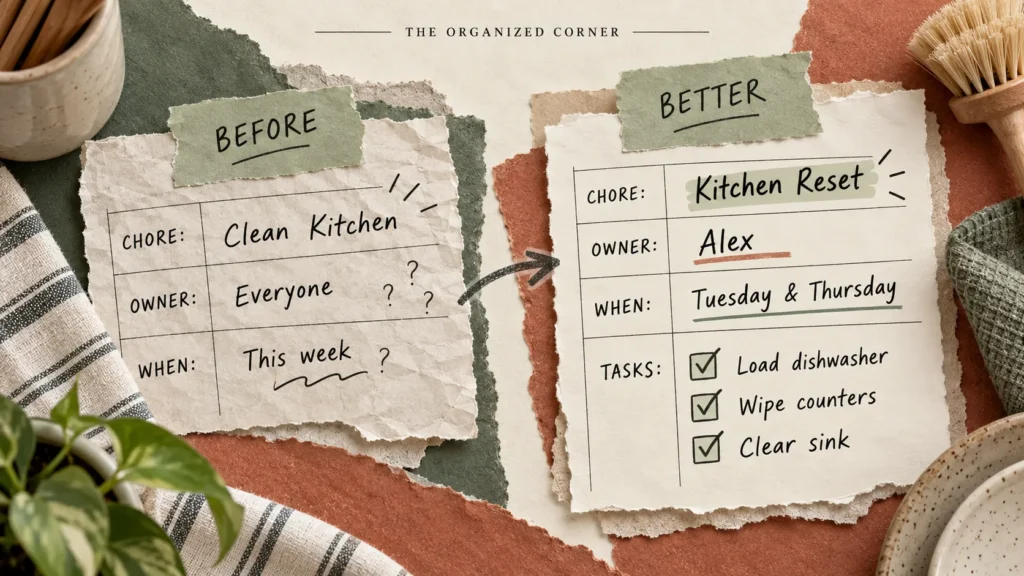
For example:
Kitchen reset
- load dishwasher
- wipe counters
- return food and dishes
- clear the sink
Now everyone knows what “done” means.
The clearer the task, the fewer follow-up reminders it usually needs.
3. Remove Chores That Don’t Need to Be on the Chart
Sometimes the chart stops working because it contains too much.
If every tiny household action is listed, people stop noticing the important tasks.
Ask:
Does this chore actually need tracking?
Keep the chart focused on recurring responsibilities that:
- get forgotten
- cause disagreement
- need a clear owner
- affect the household when missed
You probably don’t need to track every small action someone already does automatically.
Simpler charts are easier to read and easier to maintain.
4. Match the Chore to the Person
A chore chart doesn’t need to be mathematically equal.
It needs to be reasonably workable.
Consider:
- age
- available time
- work or school schedule
- physical ability
- how long the task takes
- how often the task happens
Giving someone a large chore on their busiest day and then wondering why it is repeatedly missed isn’t really a chart problem.
It’s a scheduling problem.
Move the job, change the frequency or assign it differently.
5. Stop Using Reminders as the Entire System
If you still need to remind someone every single time, the chart hasn’t really replaced the old system.
Try connecting chores to predictable triggers.
Instead of:
Take the bins out sometime Thursday.
use:
Thursday after dinner — bins.
Instead of:
Do laundry this weekend.
use:
Saturday morning — start bedding load.
A clear when can be just as important as a clear who.
6. Build in a Backup for Busy Days
Households are not predictable every week.
Someone works late.
A child has an activity.
Someone gets sick.
A rigid chore chart can break as soon as normal life interrupts it.
Create simple backup rules:
If the owner can’t do it:
the backup person takes over.
If the task isn’t urgent:
move it to the next realistic day.
If the week is overloaded:
do the essential version only.
This works especially well alongside a cleaning schedule for busy people, where workdays and days off don’t carry the same workload.
7. Review the Chart Instead of Blaming the People Using It
If the same chore keeps failing, treat that as information.
Ask:
Is the task too vague?
Is the timing unrealistic?
Does the owner know what finished means?
Does this chore need to happen this often?
Is someone carrying too much?
Then adjust the system.
A five-minute review once a week can be more useful than adding another week of reminders.
Your weekly home reset checklist is a natural time to review responsibilities, move unfinished tasks and decide what actually matters for the coming week.
A Chore Chart Should Reduce Reminding
A chore chart isn’t working if one person still has to:
notice every task,
assign every task,
remind everyone,
check every task,
and fix anything that was missed.
The chart should make responsibilities more visible—not create another thing for one person to manage.
Start by fixing the basics:
one owner,
one clear task,
one realistic time,
one definition of done.
Then keep the system flexible enough to change when real life does.
Sometimes the best chore chart isn’t the most detailed one.
It’s simply the one everyone can understand and actually use.
Frequently Asked Questions
Why is my chore chart not working?
Common reasons include unclear task ownership, chores that are too vague, unrealistic schedules, too many tasks and relying on reminders instead of clear routines.
How do I get my family to actually use a chore chart?
Keep the chart simple, assign one owner to each task, define what completing the job means and connect chores to realistic days or routines.
Should everyone have the same number of chores?
Not necessarily. Consider how difficult and frequent each task is as well as each person's schedule, age and ability.
How often should we review a family chore chart?
A quick weekly review works well when you're establishing the system. Adjust tasks that are repeatedly missed instead of leaving the same problem on the chart indefinitely.



Join the conversation.