

If the same household jobs only get done after someone asks three times, the problem may not be the chores themselves.
It may be that nobody is completely sure who owns the task.
“Can someone take the bins out?” sounds simple, but it still leaves someone responsible for noticing the bin is full, remembering collection day and reminding everyone else.
A practical family chore chart removes some of that guesswork.
Instead of relying on reminders, everyone can see what needs doing, who is responsible and when it should happen.
Here’s how to create one without turning your home into a complicated management system.
1. Start With the Chores That Actually Matter
You do not need to write down every tiny household action.
Begin with the recurring jobs that regularly create confusion or frustration.
That may include:
- dishes
- laundry
- bins
- vacuuming
- bathroom cleaning
- feeding pets
- watering plants
- tidying shared rooms
- setting or clearing the table
Start with the tasks that someone currently has to keep remembering for everyone else.
Those are usually the best candidates for a shared system.
2. Decide How Often Each Task Needs Doing
Not every chore belongs on a daily schedule.
Some need attention every day.
Others may only need doing once a week.
You might group tasks as:
Daily
Dishes, pet care, kitchen reset, basic tidying.
A few times a week
Laundry, vacuuming busy areas, bins.
Weekly
Bathrooms, changing bedding, deeper floor cleaning.
Occasionally
Fridge cleaning, windows, seasonal tasks.
The goal is to create a schedule based on your actual home rather than copying a routine that looks good online.
3. Give Every Chore One Clear Owner
This is one of the most important parts.
Avoid writing:
Everyone helps with the kitchen.
That sounds fair, but nobody knows who is expected to notice when something needs doing.
Instead:
Kitchen counters — Alex
Dishwasher — Sam
Bins — Jamie
One person should know that the task belongs to them.
That doesn’t mean nobody else can help. It simply removes uncertainty.
When responsibility is shared by “everyone,” it can easily become responsibility for no one.
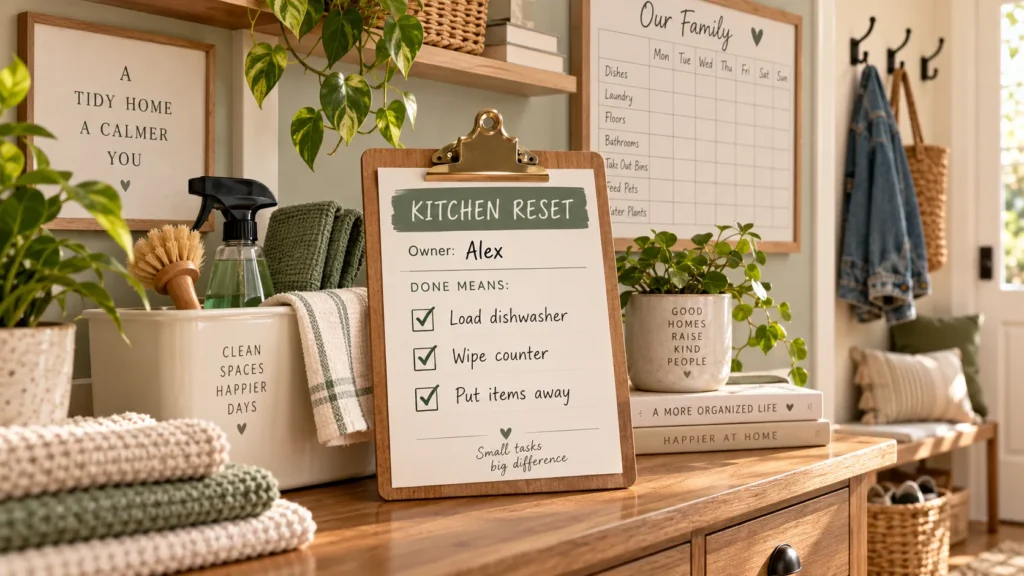
4. Define What “Done” Means
A surprisingly common source of household frustration is that two people can have completely different ideas of what completing a chore means.
For example:
“Do the laundry” could mean:
- put clothes in the washing machine
- wash and dry them
- fold them
- return them to the correct rooms
Those are very different definitions.
Try making the expected finish point clear.
Instead of:
Clean the kitchen.
Use:
Load the dishwasher, wipe the counters and return food to the cupboards.
Instead of:
Tidy the living room.
Use:
Return loose items, fold blankets and clear the coffee table.
Clear expectations reduce the need for follow-up reminders.
5. Make the Chore Chart Easy to See
A chore chart only works if people can actually find it.
Good places might include:
- fridge
- kitchen wall
- family command area
- hallway
- utility room
- shared digital space
Keep it somewhere connected to everyday life rather than tucked inside a drawer.
The chart should answer three questions quickly:
What needs doing?
Who owns it?
When does it need doing?
If someone needs five minutes to understand the chart, simplify it.
6. Connect Chores to Your Weekly Cleaning Routine
A family chore chart becomes much easier to maintain when it fits into the cleaning routine you already use.
For example, if Wednesday is your main floor-cleaning day, the person responsible for vacuuming should be able to see that clearly.
If you haven’t built a manageable home-cleaning structure yet, start with our weekly cleaning routine and then divide the relevant jobs between household members.
This helps prevent the chore chart from becoming a completely separate system that nobody remembers to follow.
7. Match Responsibilities to the Person
Fair does not always mean every person does the exact same number of tasks.
Consider:
- age
- schedule
- physical ability
- school or work commitments
- how long each task takes
- how often the job needs doing
One person may have two larger weekly chores.
Another may have several small daily responsibilities.
The goal is not mathematical equality.
The goal is making household work clearer and reasonably shared.
8. Have a Backup Plan
Life happens.
Someone gets sick.
A workday runs late.
A child has school activities.
Instead of letting one missed chore derail the entire routine, decide what happens when the assigned person cannot complete it.
That may mean:
- another person acts as backup
- the task moves to the next day
- a non-urgent job waits until the weekend
A flexible system tends to last longer than one that expects every week to run perfectly.
9. Review the Chore Chart Once a Week
Your first version probably won’t be perfect.
That’s fine.
Once a week, take a few minutes to ask:
Which tasks worked well?
Which chores were repeatedly missed?
Does one person have too much?
Is anything on the chart unnecessary?
Does someone need a clearer definition of the task?
Then make small adjustments.
A family chore chart should evolve with the household rather than becoming another rigid rule.
A Good Chore Chart Reduces Reminding
The real purpose of a family chore chart isn’t to create a perfectly managed home.
It’s to make responsibility visible.
Everyone should know:
what needs doing,
who owns it,
when it needs doing,
and what completing it actually looks like.
When those things are clear, one person no longer has to carry all of the invisible work of remembering, assigning and following up.
And that can make household routines feel much easier.
Frequently Asked Questions
How do you make a family chore chart?
Start with the household tasks that regularly need reminders, decide how often each one needs doing and assign one clear owner to each responsibility.
Should every family member have the same number of chores?
Not necessarily. A fair system should consider age, available time, difficulty and how often each task needs doing rather than simply giving everyone the same number.
Where should a family chore chart be kept?
Keep it somewhere household members regularly see, such as the kitchen, fridge, hallway or family command area.
How often should a chore chart be updated?
Review it weekly at first. Once the system works well, you may only need to adjust it when schedules or household responsibilities change.



Join the conversation.