
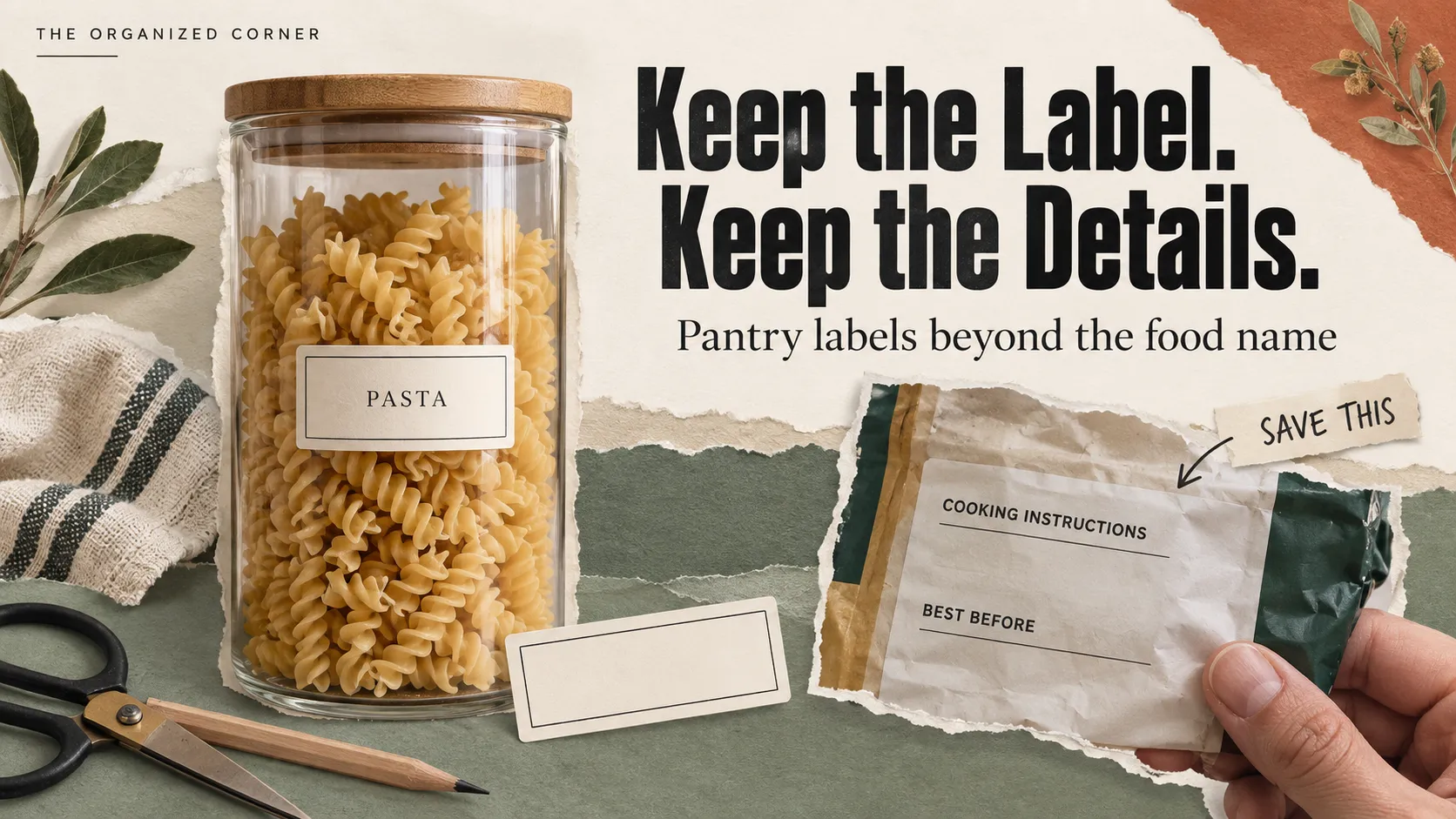
Decanting pasta, rice, flour or cereal into containers can make a pantry easier to see and easier to use.
But once the original bag goes in the bin, something else can disappear with it:
the cooking instructions,
the date,
ingredient information,
allergen details,
or storage directions.
That is why learning how to label decanted food is about more than putting the food name on the front of a jar.
A simple pantry label tells you what is inside.
The original packaging often tells you everything else you may still need.
The goal is to keep both kinds of information without making your pantry complicated.
What Should You Put on a Decanted Food Container?
At minimum, clearly label the container with the food name. Before discarding the original packaging, also check whether you need to preserve the best-before or use-by date, cooking instructions, ingredients, allergen information, storage directions or identifying product details. Keep changing information separate from the simple organization label when possible.
Decanted Food Label Checklist
On the container:
✓ Food name
Keep accessible when relevant:
✓ Best-before/use-by information
✓ Cooking or preparation instructions
✓ Ingredients
✓ Allergen information
✓ Storage instructions
✓ Brand/product variety
✓ Batch or lot details when useful
1. Start With the Food Name
Every decanted container should be easy to identify at a glance.
For most pantry staples, the front label can stay very simple:
Pasta
Rice
Oats
Flour
Lentils
Clear names are more useful than overly decorative wording.
If several people use the pantry, choose the terms everyone in the household already understands.
Our guide to labeling a pantry goes deeper into deciding which containers, baskets and pantry categories actually need labels.
2. Keep the Date Information You May Need
When the original package includes a best-before, use-by or other date, don’t automatically throw that information away after decanting.
Depending on the food, you may want to:
- keep the relevant piece of packaging
- write the date on a removable label
- keep the original packet behind or beside the container
- record the information in a pantry note
Avoid guessing or inventing dates yourself.
Use the manufacturer’s original information where it matters.
And remember that different date labels can mean different things, so follow the original packaging and appropriate local food-safety guidance rather than treating every printed date the same way.
3. Save Cooking Instructions for Foods That Need Them
Some foods are easy to cook from memory.
Others aren’t.
You may not need the packet instructions for everyday rice you make every week.
But you might want them for:
- unfamiliar grains
- specialty pasta
- dried pulses
- baking mixes
- instant foods
- foods with specific water ratios
- products with unusual cooking times
If you decant one of these, save the preparation instructions somewhere easy to find.
That can be as simple as cutting out the relevant part of the packet and keeping it behind the container.
The front of the jar can still say:
COUSCOUS
while the useful instructions stay nearby.
4. Don’t Lose Ingredient or Allergen Information
This is one of the most important details to keep.
If the original packaging contains ingredient or allergen information that someone in your household may need, do not rely on your decorative pantry label as a replacement.
A label saying:
Granola
doesn’t tell you whether that particular product contains nuts, milk, gluten or another ingredient someone needs to avoid.
Keep the original packaging information available where necessary.
This is especially important if:
- someone in the household has food allergies or intolerances
- similar products use different ingredients
- multiple brands are stored in similar containers
- guests or caregivers may prepare food
Your organization system should make food easier to identify—not remove information someone relies on.
5. Keep Storage Instructions When They Matter
Some foods have specific instructions after opening.
For example, packaging may tell you to:
- refrigerate after opening
- keep somewhere cool and dry
- use within a certain period
- reseal carefully
- protect the product from moisture or light
If those instructions matter to the product, preserve them.
Don’t assume that moving something into a nicer container changes how it should be stored.
The container organizes the food.
It doesn’t rewrite the manufacturer’s storage guidance.
6. Keep Batch or Product Details When They Could Be Useful
You do not need to turn every pantry jar into a database.
But there are situations where keeping more of the original label makes sense.
You may want to retain:
- brand name
- exact product variety
- batch or lot details
- barcode
- manufacturer information
especially if there is a product issue, recall, dietary requirement or another reason you may need to identify the original product later.
For everyday low-risk organization, you can keep the system simple.
The point is to avoid throwing away information before deciding whether you still need it.
7. Use a Two-Layer Labeling System
One easy approach is to separate organization information from product information.
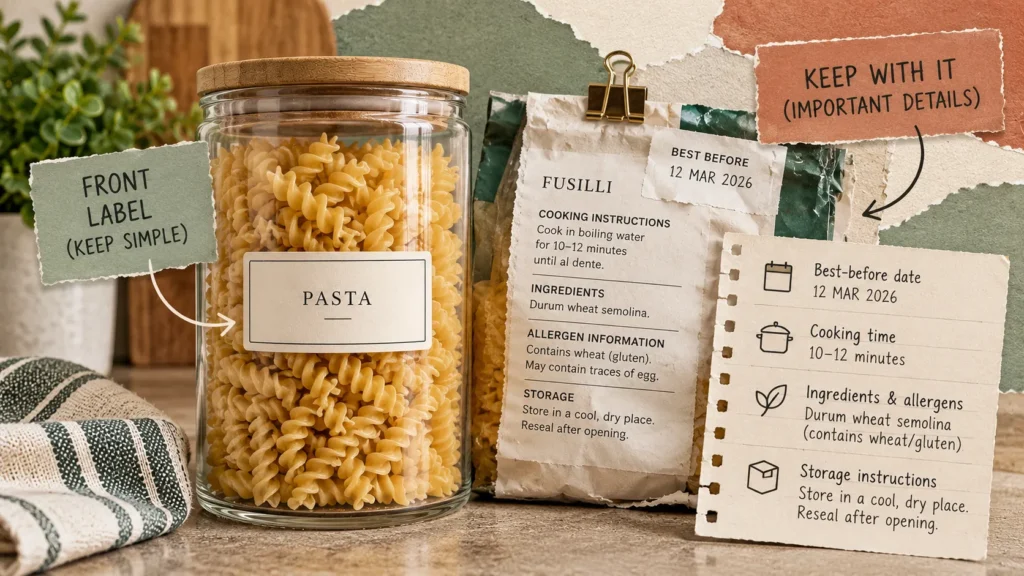
Front of container
Keep this simple:
Pasta
Back, underside or nearby note
Keep any useful details such as:
- best-before date
- cooking instructions
- brand
- original packaging snippet
That gives you a clean pantry without forcing every useful detail onto the front of the jar.
It also means your organization labels stay readable.
8. Don’t Mix Different Products Without Checking
It can be tempting to top up a half-full container with a new package.
Sometimes that’s straightforward.
But if the new packet has a different:
- date
- ingredient list
- allergen profile
- cooking time
- product variety
mixing them can make the information harder to track.
If the details differ, consider finishing the older product first or keeping the batches separate.
This is particularly helpful when you’re also maintaining a pantry inventory, because you can keep your stock record more accurate instead of treating different products as one indistinguishable supply.
9. Connect Labels With Your Pantry Inventory
Your labels answer:
What is this?
Your inventory answers:
How much do I have and do I need more?
Those two systems work best together.
For example:
Container: Pasta
Inventory: Pasta — running low
You don’t need to squeeze stock information onto every physical label.
Use the container label for identification and your inventory for changing information.
If your inventory is already becoming too detailed to maintain, our guide on how to keep a pantry inventory explains how to track essentials without obsessively recording every item.
10. Don’t Decant Something Just Because You Can
Not every pantry product becomes easier to use when removed from its original packaging.
Before transferring something, ask:
Will this actually make storage easier?
Will I still have the information I need?
Does the food need special storage?
Will I refill this container regularly?
Sometimes the simplest option is leaving the food in its original packaging and placing it inside a labelled basket.
That’s still an organized pantry.
The goal isn’t to eliminate packaging.
It’s to make food easier to find and use.
Keep the Name Simple—and Keep the Information That Matters
A pantry label doesn’t need to contain an essay.
Usually, the front only needs to tell you what is inside.
But before throwing away the original package, check whether you still need:
the date,
cooking instructions,
ingredients,
allergen information,
storage directions,
or other identifying details.
Keep the label simple.
Keep the useful information.
Then your pantry can look organized without losing the details that help you use the food properly.
Frequently Asked Questions
What information should I put on a decanted food container?
At minimum, clearly identify the food. Depending on the product, you may also want access to the original date, cooking instructions, ingredients, allergen information and storage guidance.
Should I write the best-before date on pantry containers?
If that date is useful for the product, keep it somewhere accessible—either on a removable label, on the saved package information or in another simple record.
Can I throw away the original packaging after decanting food?
Only after checking whether it contains information you may still need, such as ingredients, allergens, dates, cooking instructions or storage directions.
Do pantry labels replace original food labels?
No. Organization labels help identify food and storage categories; they should not replace important manufacturer information.
How should I label pantry containers after decanting food?
Put a clear food name on the front of the container. Keep dates, allergen information, cooking instructions and other changing product details on a removable label, the saved packaging or another accessible record when they are relevant.
Join the conversation.