
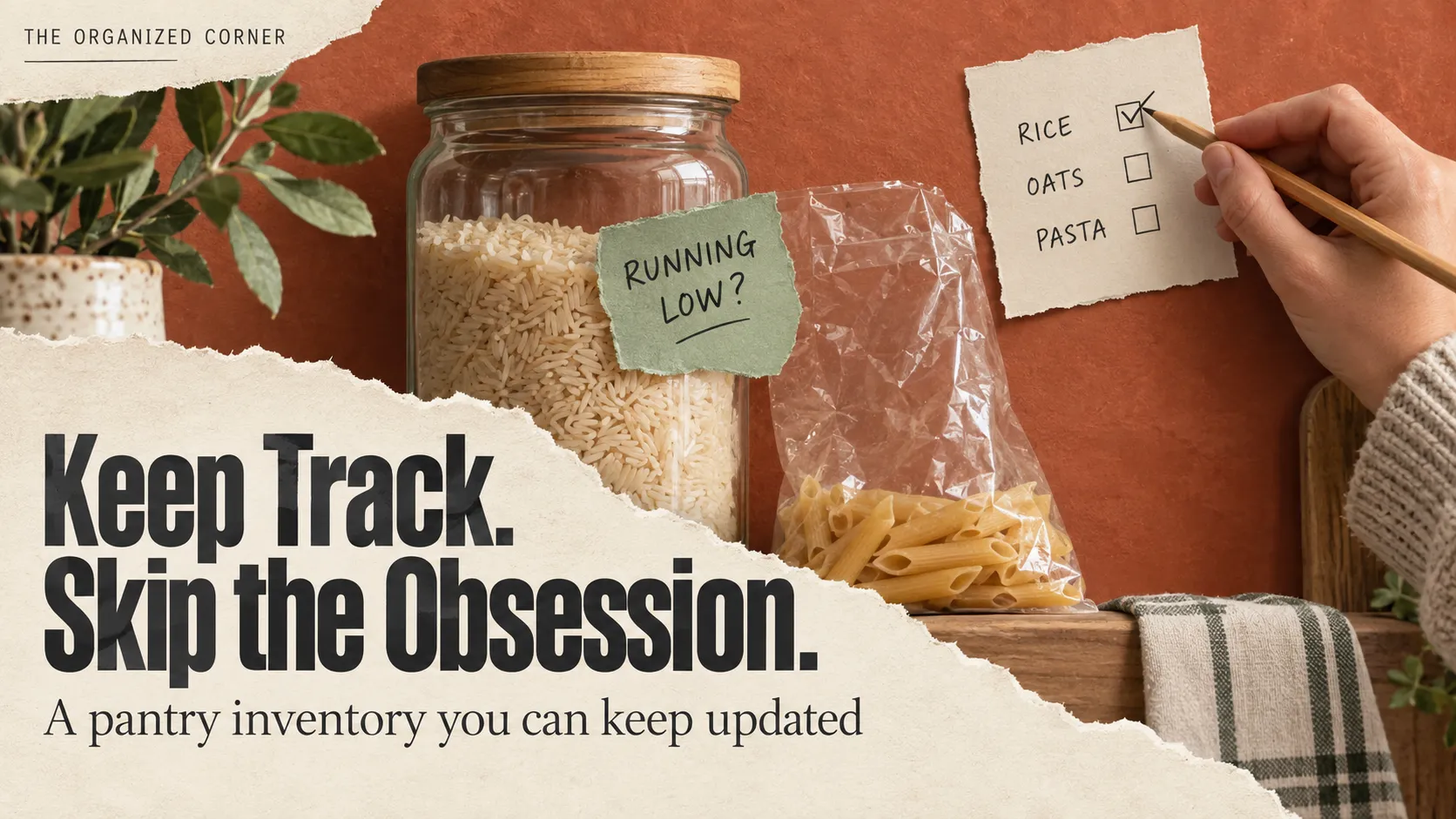
A pantry inventory sounds useful until it starts feeling like another system you have to maintain perfectly.
You buy rice.
You use pasta.
Someone finishes the oats.
Suddenly the list is already out of date.
That doesn’t mean pantry inventories don’t work.
It usually means the system is trying to track too much.
If you’re wondering how to keep a pantry inventory without constantly updating quantities, the answer is to make it simpler.
Track the foods that actually affect your shopping decisions.
Notice what is running low.
Update the list at natural moments.
And accept that your inventory does not need to be perfectly accurate every minute of the day.
If you’re creating an inventory for the first time, start with our pantry inventory system guide. This article focuses on keeping that inventory useful and updated once it’s already in place.
How Do You Keep a Pantry Inventory Updated?
Keep a pantry inventory manageable by tracking only the foods that affect your shopping decisions, using simple statuses such as Enough, Running Low and Out, and updating the list when groceries arrive, when you open the last backup item or before grocery shopping. The system does not need to be perfectly accurate it only needs to be reliable enough to help you decide what to buy and use next.
The 3 Best Times to Update Your Pantry Inventory
- When groceries come home
Update anything you’ve restocked while putting food away. - When you open or finish the last backup
Move the item to Running Low or Out immediately. - Before grocery shopping
Spend two minutes checking your inventory and restocking list.
1. Keep Your Pantry Inventory Small Enough to Maintain
You probably don’t need a detailed record of every spice packet, snack bar and half-used ingredient.
Start with the foods you buy repeatedly.
For example:
- rice
- pasta
- oats
- cereal
- flour
- sugar
- tinned tomatoes
- beans
- cooking oil
- coffee
- frequently used snacks
These are the items that are easiest to accidentally buy twice or forget completely.
A smaller inventory is much easier to maintain than a list containing everything in the kitchen.
2. Use Simple Statuses Instead of Exact Numbers
Exact quantities can be useful, but they also create more updating.
For everyday pantry staples, simple statuses may be enough:
Enough
No action needed.
Running low
Add it to the next shopping list.
Out
Replace it if it’s something you regularly use.
This keeps the system useful even if the exact amount changes between updates.
You don’t always need to know whether you have 620 grams of rice.
You may only need to know:
Rice — running low.
3. Update the Inventory When Something Changes
You do not need a special daily inventory session.
Update the list when an obvious change happens.
For example:
- you finish a staple
- you open the last backup packet
- groceries come into the house
- you move food between storage areas
- you notice something that needs using soon
These are natural moments when the inventory can be adjusted in a few seconds.
That’s much easier than scheduling another household task called:
Update pantry inventory.
4. Keep the Inventory Close to Where You Use It
The easier the list is to access, the more likely you’ll update it.
Depending on how you prefer to work, you might keep it:
- inside a pantry door
- on the fridge
- in a kitchen binder
- on a clipboard
- as a fillable digital PDF
- in a simple note on your phone
There isn’t one correct format.
The best system is the one you can reach at the moment you notice something is low.
5. Track Location When Food Is Spread Around
Sometimes the problem isn’t forgetting what you own.
It’s forgetting where it is.
If you store food across several cupboards, shelves or pantry areas, use simple locations.
For example:
P1 — main pantry shelf
P2 — baking cupboard
P3 — breakfast shelf
Then your inventory can show:
Oats — P3
Flour — P2
Pasta — P1
This becomes even more useful in larger kitchens or when other household members also put groceries away.
Your Pantry & Freezer Inventory Planner includes a storage-location organizer specifically for this purpose.
6. Keep a Running-Low List Separate From the Full Inventory
Your complete inventory tells you what you have.
Your shopping list should tell you what you need.
Those are different jobs.
As soon as something moves into running low, add it to a short restocking list.
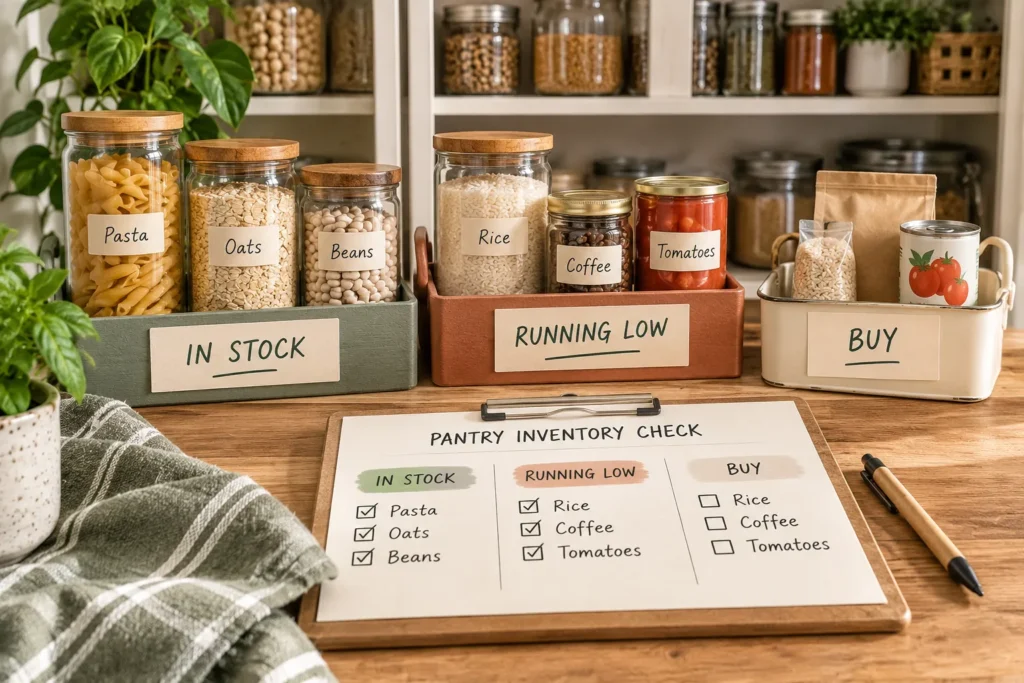
That means you don’t need to scan your entire inventory every time you shop.
For example:
Running low
- rice
- coffee
- tinned tomatoes
That’s enough information to make the next grocery trip more focused.
7. Review the Pantry Before Weekly Meal Planning
One of the best times to check your inventory is before deciding what to cook.
Look for:
- food that is already open
- ingredients you have plenty of
- items that need using soon
- staples that are missing
Then build meals around those foods.
This is why your inventory works so well with weekly meal planning.
Instead of choosing seven meals first and buying everything for them, you can let the food you already own influence the plan.
Our weekly meal planning guide also starts by checking the fridge, freezer, cupboards and pantry before writing the shopping list.
8. Use a “Use First” List for Food That Keeps Getting Ignored
Some foods don’t need restocking.
They need using.
Maybe you have:
- an opened bag of lentils
- a jar of sauce
- several tins of beans
- an ingredient bought for a recipe that never happened
Instead of leaving those items buried in the full inventory, create a short Use First list.
Choose only two or three items.
Then give them a purpose.
For example:
Use first this week
Lentils → soup
Tomatoes → pasta sauce
Beans → rice bowls
Your Pantry & Freezer Inventory Planner includes a dedicated use-first planning sheet for exactly this kind of step.
9. Don’t Restart the Whole System When You Miss an Update
This is where a lot of inventory systems fail.
You forget to update two things.
Then five things.
Then you assume the whole list is useless and start again from scratch.
You don’t need to.
Just correct what you notice.
If the rice quantity is wrong, fix the rice.
If the pasta is missing, add the pasta.
If one pantry area seems inaccurate, quickly review that area.
A useful inventory can be imperfect.
It simply needs to give you a better picture than memory alone.
10. Do a Quick Reset Before Grocery Shopping
Right before a larger shop, spend two minutes checking:
What is running low?
What is completely out?
What do I already have enough of?
Is anything on the list that I actually already own?
This tiny check is often enough to prevent duplicate purchases.
If you’re still building your first inventory rather than maintaining one, start with the broader pantry inventory system guide, which covers grouping foods, tracking staples and checking stock before shopping.
11. Let the System Stay Simple
A pantry inventory should reduce decisions.
It shouldn’t create more of them.
You do not need:
a barcode scanner,
a complicated spreadsheet,
exact weights for every ingredient,
or a perfectly current record of every snack in the house.
You need enough information to answer:
Do I have this?
Is it running low?
Where is it?
Do I need to buy more?
If the system can answer those four questions, it is already doing its job.
Your Pantry Inventory Does Not Need to Be Perfect
The goal isn’t perfect stock control.
It’s fewer duplicate purchases, fewer forgotten ingredients and easier grocery decisions.
Track the foods you buy regularly.
Use simple statuses.
Update the list when something naturally changes.
Keep a short restocking list.
Review your stock before meal planning and shopping.
And if the inventory falls slightly behind?
Update what matters and keep going.
A system you maintain imperfectly is much more useful than a perfect system you abandon after two weeks.
Frequently Asked Questions
How do I keep a pantry inventory updated?
Update it when food is added, finished or noticeably running low rather than trying to check every item every day.
Do I need to track exact pantry quantities?
No. Simple statuses such as Enough, Running Low and Out may be enough for many everyday staples.
How often should I check my pantry inventory?
Do a quick check before meal planning or grocery shopping and update individual items whenever you notice a meaningful change.
What foods should I include in a pantry inventory?
Start with frequently purchased staples and foods you're most likely to duplicate or forget, such as rice, pasta, cereals, baking ingredients, beans, sauces and everyday snacks.

Join the conversation.