
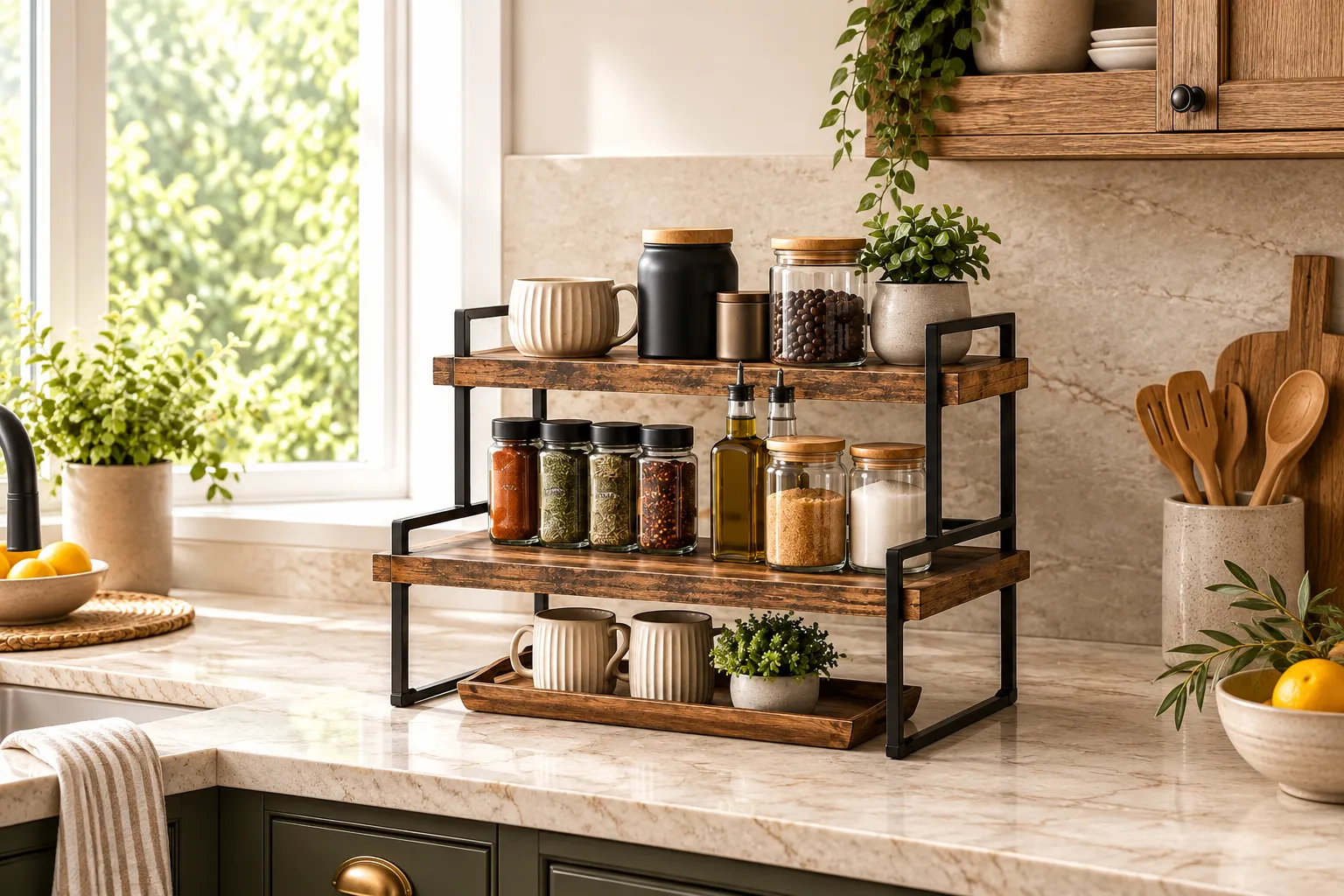
A small kitchen counter can become crowded surprisingly quickly.
A coffee maker stays out because you use it every morning. Cooking oil sits beside the stove. Mail lands near the fridge. A few mugs stay beside the kettle, and suddenly there is barely enough open surface left to prepare dinner.
The answer isn’t always another shelf.
The most useful small kitchen countertop storage ideas start by deciding what genuinely needs to live on the counter and then choosing the simplest storage solution for what remains.
Sometimes that’s a tray.
Sometimes it’s a basket.
Sometimes vertical storage makes sense.
And sometimes the best countertop organizer is actually an empty section of counter.
1. Decide What Actually Deserves Counter Space
Before adding storage, look at everything currently sitting out.
The easiest countertop space should usually go to items you use frequently.
A coffee maker used every morning probably earns its place.
An appliance used twice a year probably doesn’t.
Ask one question for each item:
Would moving this into a cabinet make everyday life noticeably harder?
If not, consider moving it.
The goal is not to create an empty showroom kitchen. It is to keep the countertop available for the things that actually happen there.
For a broader kitchen reset, our small kitchen organization ideas guide explains how to prioritize storage based on how often items are used.
2. Protect One Clear Preparation Zone
Before creating coffee stations, cooking zones or decorative displays, protect somewhere to actually prepare food.
Choose one section of counter that stays mostly clear.
It might be beside the sink, next to the stove or near your chopping boards.
Avoid slowly filling that area with storage simply because there is still technically room.
A small clear workspace can be more valuable than another six inches of organizer capacity.
3. Use a Tray for Small Everyday Items
Not every countertop problem requires vertical storage.
A simple tray can work well for a small number of items such as cooking oil, salt, pepper or coffee essentials.
The tray creates a visual boundary.
Instead of four separate objects appearing scattered across the counter, they become one defined group.
It also makes cleaning easier because the whole group can be moved at once.
This works best when you genuinely only have a few items to contain.
4. Use a Basket or Caddy for Things That Move
Some countertop items don’t need a permanent fixed position.
A small caddy can work better when items regularly move between spaces.
For example, breakfast supplies might come out in the morning and return to a cupboard afterward.
A handled basket could hold tea, coffee or condiments that are used together.
This keeps the group organized without permanently sacrificing countertop space.
The advantage is flexibility.
You can move the entire category instead of finding another place for every individual item.
5. Choose a 2-Tier Organizer When You Only Need One Extra Level
Vertical storage can be useful—but choose the lowest option that solves the problem.
A 2-tier countertop organizer works well when you have a small group of everyday items and simply need one additional storage surface.
The important considerations are the footprint, upper-cabinet clearance and usable space between the two shelves.
If two levels sound right for your kitchen, our dedicated 2-tier countertop organizer guide explains what to measure and how to decide whether the shelf spacing will actually work for your belongings.
This article doesn’t need to repeat all those details.
That’s what the dedicated 2-tier page is for.
6. Use a 3-Tier Organizer Only When All Three Levels Will Be Useful
Three tiers provide more vertical capacity, but more storage isn’t automatically better.
A 3-tier shelf can work when you have enough height, several smaller frequently used items and a genuine purpose for all three levels.
It may be less useful when:
upper cabinets are low, the top shelf is difficult to reach, or tall containers don’t fit between levels.
Our separate 3-tier countertop organizer guide covers accessibility, shelf spacing, weight distribution and deciding whether three levels are actually worth the extra height.
Keeping that discussion on its own page prevents this broader guide from turning into another tiered-organizer article.
7. Look Beyond the Countertop Itself
When countertop space is extremely limited, adding something onto the counter may not be the best solution.
Depending on your kitchen, useful alternatives might include wall rails, hooks, magnetic storage, under-cabinet options or storage mounted inside cabinet doors.
The important principle is simple:
use nearby unused space before covering more preparation space.
This can be particularly useful for lightweight items that don’t need to remain on the worktop itself.
Always choose storage appropriate for the surface, weight and installation method involved.
8. Move Occasional Appliances Out of Prime Space
Small appliances can take up more countertop area than everything else combined.
Look at each appliance and ask how often you genuinely use it.
Your everyday kettle or coffee maker may stay.
But an appliance used once every few weeks could potentially move to a cabinet, pantry or another appropriate storage area.
Don’t make an appliance difficult to access simply for the sake of appearance.
But also don’t give permanent prime space to equipment that rarely gets switched on.
9. Organize the Counter Around Tasks
Your countertop becomes easier to maintain when related things stay near where they’re used.
Think in practical zones.
A coffee area might contain the coffee maker, mugs and only the most frequently used supplies.
A cooking area might contain the few oils or seasonings you reach for almost every day.
A preparation area should stay largely open.
This is very different from placing items wherever there happens to be an empty gap.
Storage works better when it supports the activity happening beside it.
10. Measure Before Adding Any Storage Product
Whether you’re considering a tray, basket, 2-tier shelf or taller organizer, measure before buying.
Check the available:
width, depth, height and upper-cabinet clearance.
Also consider nearby appliances, outlets and doors.
Our detailed guide on how to measure kitchen cabinets for organizers covers usable measurements, clear openings and obstructions if you need a more thorough measuring process.
The most attractive organizer online won’t help if it interferes with your cabinets or steals the space you needed for chopping vegetables.
11. Leave Some Empty Counter on Purpose
Empty space is not wasted storage.
In a kitchen, it is working space.
You need somewhere to:
prepare food, put down a grocery bag, plate dinner, unload ingredients or temporarily place a hot pan where appropriate.
Try not to optimize every square inch for permanent storage.
A small kitchen often feels more functional when there is somewhere things don’t live.
12. Test the Setup During a Normal Meal
Once you’ve reorganized the counter, cook something.
That is the real test.
Notice:
Can you reach what you use most?
Do you keep moving the same organizer out of the way?
Is there enough room to prepare food?
Does anything feel awkward to put back?
Are some items still sitting out even though they aren’t regularly used?
Adjust based on what actually happens.
The goal is not a perfect photograph.
The goal is a countertop that makes everyday cooking easier.
Which Countertop Storage Solution Should You Choose?
Use the simplest solution that solves the actual problem.
If you have only a few loose essentials, try a tray.
If the category moves, try a caddy.
If you need one additional level, consider two tiers.
If you genuinely need three accessible levels, a 3-tier organizer may make sense.
If the counter itself is already too limited, look at nearby vertical or cabinet storage instead.
And if removing rarely used items solves the problem?
You may not need to buy anything.
That’s often the best result.
Frequently Asked Questions
How can I create more countertop space in a small kitchen?
Start by moving rarely used items away from prime counter space and protecting one clear food-preparation area. Then use trays, baskets or vertical storage only where they solve a specific problem.
What should stay on a small kitchen counter?
Generally, keep frequently used appliances and everyday essentials that would be inconvenient to retrieve each time. Occasional items are usually better stored elsewhere.
Are tiered organizers good for small kitchen counters?
They can be. A 2-tier organizer works well when you need one additional level, while three tiers may work when you have enough vertical clearance and several smaller items to organize.
How do I organize a small counter without buying organizers?
Remove rarely used items, group related essentials, create practical work zones and use cabinets or nearby storage more effectively before purchasing anything new.
Should I leave empty countertop space?
Yes. Clear counter space is functional working space for cooking, preparing food and temporarily placing items.

Join the conversation.