
Sharing a home means sharing more than the visible chores.
Someone has to notice the laundry basket is full.
Someone remembers that the bins go out tomorrow.
Someone checks what needs buying, plans dinner, notices the bathroom needs cleaning and remembers that the guest room needs attention before visitors arrive.
That is household work too.
So when you’re figuring out how to divide household chores fairly, don’t simply count the number of tasks each person has.
Look at the time, effort, frequency and responsibility involved.
1. Start With Everything That Actually Gets Done
Before dividing chores, make a complete list.
Include the obvious jobs:
- dishes
- laundry
- vacuuming
- bathrooms
- bins
- grocery shopping
- meal preparation
Then include the less visible work:
- planning meals
- checking household supplies
- making appointments
- remembering schedules
- organizing school or work items
- noticing when something needs doing
This gives you a much more realistic picture of the household workload.
A chore chart that only lists visible cleaning can make one person appear to have fewer responsibilities when they’re actually managing much of the planning.
2. Compare Effort, Not Just the Number of Tasks
Five small chores aren’t necessarily equivalent to two large ones.
For example:
Emptying the bins: 10 minutes twice a week
is very different from:
Laundry: sorting, washing, drying, folding and putting away several loads.
When dividing responsibilities, consider:
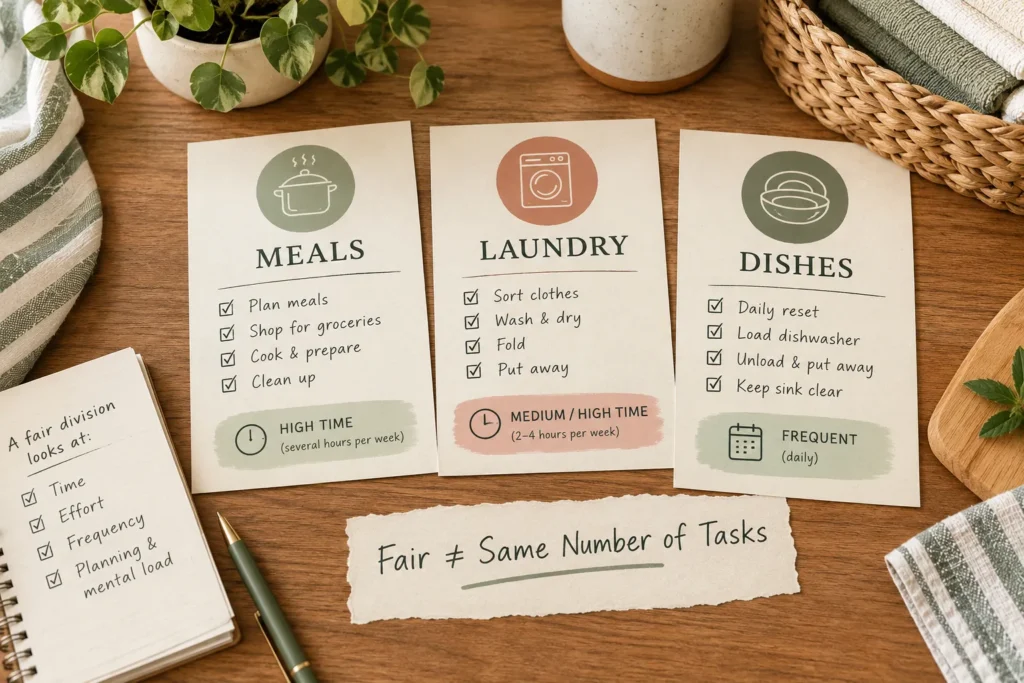
How long does it take?
How often does it happen?
How physically demanding is it?
Does it require planning as well as doing?
A fair system aims for a reasonably balanced workload—not an identical number of checkboxes.
3. Match Chores to Real Schedules
Fairness also depends on when people actually have time.
Someone who works late every weekday may not be the best person for a chore that needs attention every evening.
Someone else may have more flexibility but less availability on weekends.
Look at the household week as a whole.
You might decide that:
Person A: weekday kitchen reset
Person B: weekend laundry
Person C: bins and recycling
The exact division doesn’t matter as much as making it realistic.
Your cleaning schedule for busy people can help here because it separates shorter workday responsibilities from larger tasks that can happen on days off.
4. Count the Invisible Work Too
This is where chore division often becomes unfair without anyone intending it.
The person who cooks isn’t necessarily doing only “cooking.”
They may also:
plan meals,
check ingredients,
make the grocery list,
notice what’s running low,
shop,
and decide what dinner will be.
Similarly, the person who manages laundry may be responsible for noticing when clothes need washing and making sure important items are ready.
When you divide household work, include the mental load of noticing, planning and remembering.
Otherwise, one person can become the household manager even when the visible chores appear evenly divided.
5. Don’t Assume Fair Means Exactly Equal
Equal and fair aren’t always the same thing.
A fair arrangement might mean:
one person handles more cooking because they enjoy it, while another handles more cleaning.
One person manages weekday tasks while another takes more weekend responsibilities.
One person does fewer but longer tasks while another handles several short daily ones.
What matters is whether the overall workload is reasonable and agreed upon.
Talk about the arrangement instead of assuming everyone sees the workload in the same way.
6. Rotate the Jobs Nobody Wants
Some household responsibilities are simply unpleasant.
Bathrooms.
Bins.
Cleaning the fridge.
Scooping pet waste.
If the same person always gets the least enjoyable job, resentment can build even if the total time looks balanced.
Consider rotating certain tasks.
For example:
Week 1: Alex — bathrooms
Week 2: Jamie — bathrooms
Week 3: Alex — bathrooms
You don’t need to rotate everything.
Focus on the jobs people consistently dislike.
7. Give Each Responsibility a Clear Owner
Once you’ve decided how the workload should be divided, make the responsibility visible.
This is where a family chore chart becomes useful.
Instead of:
Everyone helps with dinner.
try:
Meal planning — Alex
Grocery shopping — Jamie
Kitchen reset — Sam
A clear owner doesn’t mean nobody else can help.
It means one person doesn’t have to keep asking who is going to remember the job.
Your existing family chore chart guide explains how to create clear task ownership and define when responsibilities need to happen.
8. Review the Balance Regularly
A chore division that works this month may not work next month.
Schedules change.
Work gets busy.
School starts.
Someone takes on a new commitment.
So review the system occasionally.
Ask:
Does the workload still feel reasonable?
Is someone repeatedly overloaded?
Are some tasks being forgotten?
Is one person still doing most of the remembering?
If something isn’t working, change the system instead of simply telling people to try harder.
Your chore chart not working guide is useful when an existing system needs troubleshooting.
Fair Chore Division Is About the Whole Workload
A balanced household isn’t necessarily one where everyone has exactly the same number of chores.
It’s one where people can see the work involved, responsibilities are clear and the overall load is reasonably shared.
Count the visible jobs.
Count the planning.
Consider time and effort.
Match responsibilities to real schedules.
Rotate the unpopular tasks.
Then review the arrangement when life changes.
The goal isn’t a perfect spreadsheet.
It’s a home where one person isn’t quietly carrying most of the responsibility while everyone else assumes the work is simply getting done.
Frequently Asked Questions
How do you divide household chores fairly?
Look at the time, effort, frequency and mental load involved rather than giving everyone the same number of tasks.
Should everyone have the same number of chores?
No. A fair division considers the size and difficulty of the responsibilities as well as each person's schedule and availability.
How do you divide chores between couples?
Start with a complete list of visible and invisible household responsibilities, then divide the overall workload based on time, effort, preferences and schedules.
What if one person feels they are doing more?
Review the complete workload together, including planning and remembering tasks. Adjust responsibilities based on what is actually happening rather than relying on the original agreement.



Join the conversation.