
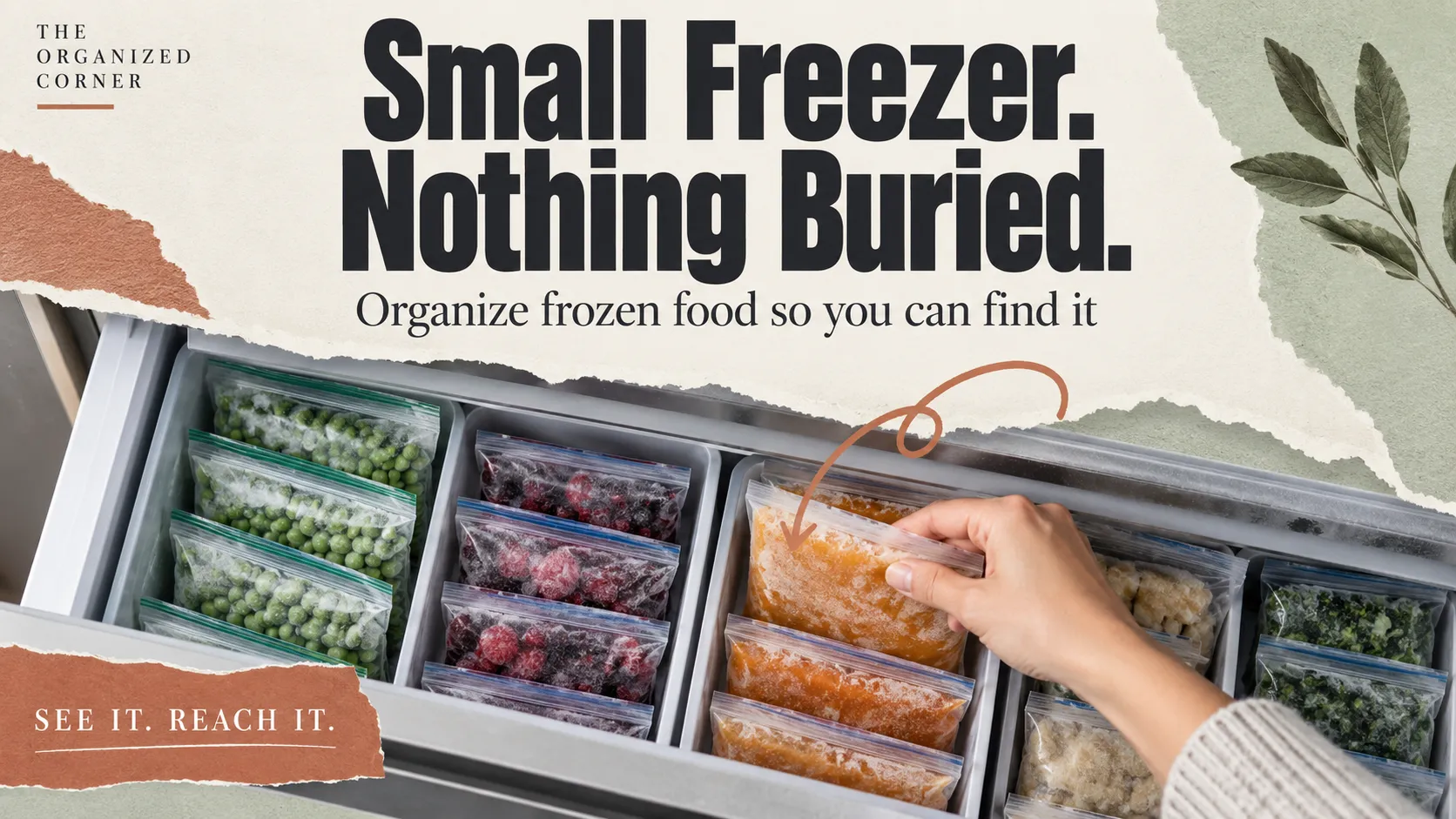
A small freezer can be surprisingly difficult to organize.
There’s less room to spread things out, so bags get stacked, frozen meals disappear underneath other food and the item you need always seems to be at the very bottom.
The problem isn’t necessarily that your freezer is too small.
It’s that every inch needs to work harder.
How Do You Organize a Small Freezer?
Start by grouping similar foods into a few simple zones, reducing deep stacks, storing packages upright where practical, keeping frequently used and use-first foods visible, and assigning drawers or side compartments clear purposes. The goal is not to fit the maximum amount of food inside—it is to make what you already have easy to see and reach.
You don’t need a perfect freezer.
You need one where you can open the drawer and quickly find what you’re looking for.
1. Start by Emptying One Section at a Time
You don’t need to empty the entire freezer onto the kitchen floor.
In a small freezer, work one drawer, shelf or section at a time.
Take everything from that section out and quickly separate it into:
- meals
- meat or protein
- vegetables and fruit
- bread or baking
- leftovers
- use-first items
Discard or handle anything you no longer need according to appropriate food-safety guidance.
The goal is to understand what is actually taking up space before putting everything back.
2. Stop Stacking Food You Need to Reach Often
Deep stacks are one of the biggest problems in a small freezer.
You can fit more food that way—but the bottom items effectively disappear.
Instead, keep frequently used foods:
- toward the front
- standing upright where practical
- in shallow baskets or containers
- in their own visible section
You want to be able to see what you have before moving half the freezer.
3. Use Freezer Drawers Like Filing Cabinets
If you have drawers, don’t treat them like large boxes.
Give each drawer a simple purpose.
For example:
Drawer 1: ready meals and leftovers
Drawer 2: vegetables and fruit
Drawer 3: meat and proteins
Or adjust the categories to match what your household actually freezes.
The exact categories don’t matter as much as consistency.
When every item has a predictable location, you spend less time searching.
4. Keep Similar Foods Upright
Flat bags stacked horizontally can quickly become buried.
Where the packaging allows it, stand bags upright like files in a cabinet.
This can make smaller freezer drawers much easier to scan.
You can also group upright bags with simple dividers or bins.
The aim is to make each package visible enough that you can identify it without removing everything around it.
5. Create a Small “Use First” Area
A compact freezer has less space for forgotten food.
That makes a use-first section especially valuable.
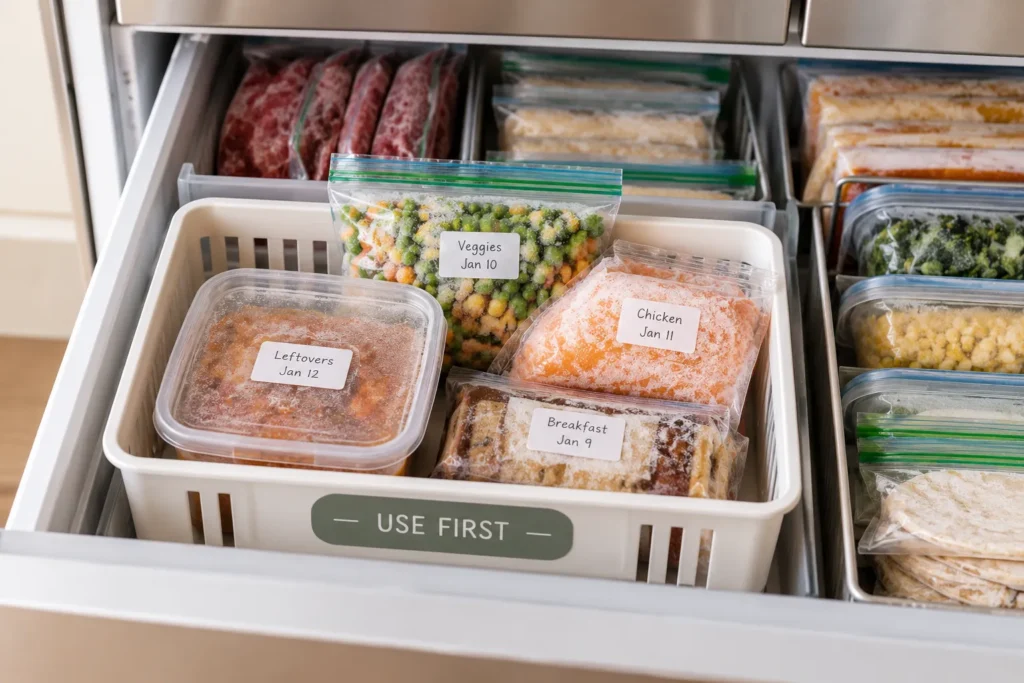
Put items there that you want to use before newer purchases, such as:
- older leftovers
- opened bags
- prepared meals
- food you’ve moved from the back
- ingredients you bought for a specific meal
Then check this section before deciding what to cook.
This works particularly well with your weekly meal planning system because you can build dinner around food that needs using instead of automatically buying more.
6. Label Containers, Not Every Frozen Item
You don’t need to label every individual bag.
Instead, label the larger storage areas when helpful.
For example:
Meals
Vegetables
Breakfast
Meat
Use First
If you freeze homemade food in reusable containers, label the container with enough information to identify what is inside.
Keep important original food information and follow the relevant packaging and food-safety guidance where applicable.
Your goal is quick identification—not a complicated labeling project.
7. Use the Door or Side Compartments Strategically
If your freezer has door shelves or narrow side compartments, use them for smaller items that are easy to lose in the main drawers.
Good candidates might include:
- frozen herbs
- small packets
- ice packs
- small portions
- frequently used accessories
Avoid placing items there simply because there is space.
Give those small compartments a clear purpose so they don’t become miscellaneous storage.
8. Put the Most-Used Foods in the Easiest Spot
In a small freezer, accessibility matters more than theoretical capacity.
Think about what your household reaches for most often.
If frozen vegetables are used several times a week, don’t put them behind seasonal baking supplies.
If leftovers are commonly used for lunch, keep them somewhere easy to see.
Storage should follow your routine.
Frequency of use should influence location.
9. Keep Food in Similar Shapes Where Practical
Different packaging shapes can create awkward gaps.
Where possible, use containers or bags that stack or stand in similar ways.
This can make the available space easier to use.
For example, a group of flat, stackable meal containers may take up less awkward space than several tall containers of different sizes.
You don’t need to replace everything at once.
Just notice where packaging is making the freezer harder to use.
10. Don’t Overfill Every Corner
A small freezer can make you feel like every centimetre must be used.
But if it becomes packed so tightly that nothing can move, you’ll lose visibility.
Leave enough room to:
- remove items safely
- see labels
- move between categories
- place new food away without creating a pile
The goal isn’t maximum capacity.
It’s usable capacity.
11. Keep a Simple Freezer Inventory
You don’t need a detailed list of every frozen pea.
For a small freezer, a short inventory can be incredibly useful because there are fewer places to hide food.
Record the things that matter most:
| Food | Quantity | Location |
|---|---|---|
| Chicken portions | 2 | Bottom drawer |
| Soup | 2 | Use First |
| Frozen peas | 1 | Vegetable drawer |
| Bread | 1 | Side section |
A simple inventory can prevent you from buying duplicates and can remind you about food that would otherwise disappear from memory.
Our broader freezer organization ideas guide explains the general inventory approach, while this article focuses specifically on making that system work in a smaller space.
12. Check the Freezer Before Grocery Shopping
Make a quick freezer check part of your normal shopping routine.
Look at:
What do I already have?
What’s running low?
What should be used soon?
What can become a meal?
This is especially useful when a freezer is small because duplicate purchases can consume valuable space very quickly.
If you already use a pantry inventory system, extend the same habit to your freezer so you can check existing food before buying more.
13. Reset the Freezer in Two Minutes
You don’t need to reorganize the freezer every week.
Instead, do a tiny reset whenever things begin drifting.
Pull the front row forward.
Return misplaced bags.
Move use-first food where you can see it.
Update one or two inventory items.
That’s usually enough to prevent a small freezer from gradually turning back into a buried pile.
14. Organize Around How Your Freezer Is Built
Not every freezer is shaped the same way.
You may have:
- shallow drawers
- deep drawers
- a top shelf
- narrow door shelves
- a compact upright
- a freezer built into a refrigerator
Don’t copy someone else’s exact layout.
Work with the physical space you actually have.
A system that fits your freezer is more useful than an attractive setup designed for a completely different appliance.
A Small Freezer Can Still Be Easy to Use
A smaller freezer doesn’t need a complicated organization system.
It needs:
clear categories,
visible food,
less deep stacking,
a use-first area,
and a simple inventory.
Keep frequently used food accessible.
Use drawers and baskets as defined zones.
Check what you already have before shopping.
Then give the freezer a quick reset before small problems become large ones.
The goal isn’t to make a small freezer look perfect.
It’s to open it and know where dinner is.
Frequently Asked Questions
How do I organize a small freezer?
Start by grouping similar foods, reducing deep stacks and giving each drawer or shelf a simple purpose. Keep frequently used items somewhere easy to see and reach.
How do I organize a small freezer drawer?
Use upright bags or shallow containers where practical, group similar foods together and place frequently used items toward the front.
How do I stop food from getting buried in my freezer?
Avoid deep horizontal stacks, create visible categories and maintain a small use-first area for older leftovers and items that need using soon.
How often should I reorganize a small freezer?
You don't need a complete reorganization frequently. A quick reset whenever items become misplaced can keep the system working.
Should I keep a freezer inventory?
A simple inventory can help you remember what you already have, avoid duplicate purchases and use frozen food before buying more. The Pantry & Freezer Inventory Planner includes a dedicated freezer tracker for this purpose.

Join the conversation.