
Getting rid of obvious clutter is usually the easy part.
Broken packaging can go. Empty bottles can go. Things you already planned to donate can go.
Then you reach the harder items.
The extra mug.
The sweater you might wear again.
The cable you’re not completely sure belongs to anything.
The kitchen tool you haven’t touched in two years—but what if you need it next month?
If you’re wondering how to decide what to keep when decluttering, the answer isn’t to force yourself to throw everything away.
It’s to stop letting “just in case” make every decision for you.
How Do You Decide What to Keep When Decluttering?
Keep an item when you genuinely use or value it, it serves a clear purpose in your current life, and keeping it makes more sense than replacing or borrowing it later. Be more cautious with items you keep only because you might need them someday, especially when they are inexpensive, replaceable, duplicated or taking up valuable storage space.
7 Questions to Ask When Deciding What to Keep
Before keeping an item, ask:
- Do I actually use it?
- Does it serve a specific purpose in my life now?
- Do I already own something that does the same job?
- Would it be difficult or expensive to replace?
- Is it worth the storage space it takes up?
- Am I keeping it for my current life or an imagined future one?
- Would I choose to give this item space in my home again today?
If you’re still unsure, use the guide below to work through each decision more carefully.
1. Remove the Easy Clutter Before Making Hard Decisions
Don’t begin your decluttering session with your hardest belongings.
Remove the easy things first:
- rubbish
- broken items
- obvious duplicates
- empty packaging
- things that belong elsewhere
- items you already know you don’t want
Once those are gone, you can see the remaining space more clearly.
If you’re still at that first stage, use our guide on what to declutter first before tackling harder keep-or-let-go decisions.
2. Ask What You’re Actually Keeping It For
“Just in case” is vague.
Make it specific.
Instead of asking:
What if I need this someday?
ask:
What exact situation am I keeping this for?
For example:
Extra phone charger
You travel regularly and actually use a spare charger.
That’s a clear purpose.
Three old mystery cables
You don’t know what they connect to, haven’t used them recently and are keeping them because something might need them one day.
That’s a different decision.
The more specific you can make the imagined future use, the easier the choice becomes.
3. Look at Evidence, Not Possibility
Almost anything could be useful eventually.
That doesn’t mean everything deserves permanent storage.
Ask:
When did I last use this?
How often does that situation actually happen?
Do I already own something else that could do the same job?
Past behaviour isn’t a perfect predictor, but it gives you more useful information than imagining every possible future scenario.
An item used twice a month is different from something untouched for four years.
4. Consider How Hard It Would Be to Replace
Not every rarely used item should automatically leave.
Consider:
- replacement cost
- how difficult it is to find
- whether it is specialized
- how quickly you could replace or borrow it
- how much space it takes up
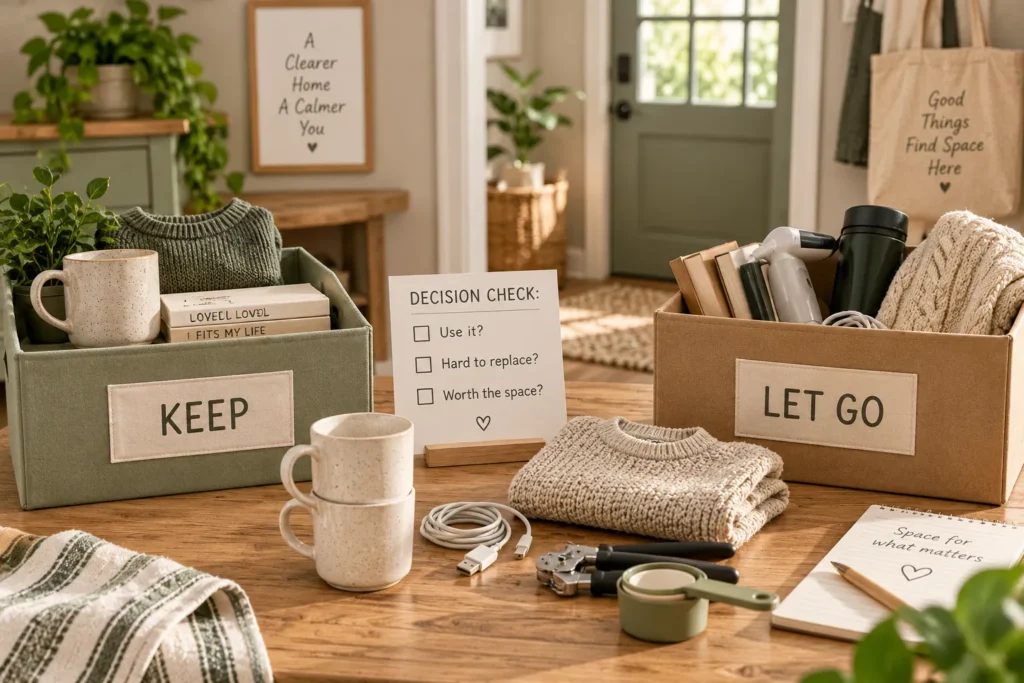
A rarely used tool that is expensive, compact and difficult to replace may make sense to keep.
A common inexpensive item that takes up half a cupboard may be easier to let go.
The question isn’t simply:
Do I use this every week?
It’s:
Does keeping this make more sense than replacing, borrowing or finding another solution if I ever need it?
5. Be More Critical With Duplicates
Duplicates are one of the easiest places for “just in case” thinking to grow.
You may genuinely need:
two sets of bed sheets,
several drinking glasses,
or backup everyday supplies.
But ask whether the number you have matches your actual life.
Do you need:
12 mugs for a two-person household?
Five nearly identical black T-shirts that never get worn?
Four kitchen tools that perform the same task?
Keep the amount that supports your routine.
The extra backup beyond that may simply be occupying space.
6. Ask Whether the Item Fits Your Life Now
Sometimes we keep things for a version of ourselves that doesn’t really exist anymore.
Clothes for a hobby you stopped doing.
Equipment for projects you no longer enjoy.
Decor from a style you’ve moved away from.
Supplies for something you repeatedly tell yourself you’ll restart “one day.”
You don’t have to get rid of every old interest.
But it’s useful to ask:
Does this support my current life—or only an imagined future one?
Your home has limited space.
The things you use now deserve room too.
7. Don’t Give Rarely Used Items Your Best Storage
Sometimes the correct decision is still keep.
That’s fine.
But a rarely used item doesn’t necessarily deserve the easiest shelf, drawer or closet space.
Move low-use items away from your highest-value storage.
Your existing guide on why your closet always feels full explains this well: seasonal and rarely used belongings can take over the most accessible areas even when everything technically fits.
Keep everyday belongings where they’re easiest to reach.
Give occasional items secondary storage.
8. Use a “Decide Later” Category Carefully
You don’t have to make every difficult decision immediately.
A small Decide Later category can help when you’re genuinely stuck.
The important word is small.
Don’t turn every uncertain item into a permanent maybe pile.
For each item you postpone, consider setting a review point.
If several months pass and you never once needed, noticed or looked for it, that gives you useful information the next time you decide.
Your Room-by-Room Decluttering Planner uses this same Keep / Move / Let Go / Decide Later approach so you don’t have to force every decision in one session.
9. Separate Sentimental Items From Ordinary Clutter
A childhood photograph and a spare kitchen whisk should not require the same decision process.
Sentimental belongings carry memories.
Deal with them separately.
When possible, finish ordinary clutter first.
Then give sentimental items the time they deserve instead of making emotional decisions while you’re already tired from sorting an entire room.
You may decide to keep them.
That’s okay.
Decluttering is not about owning the smallest possible number of things.
It’s about making intentional choices about what occupies your space.
10. Remember That Keeping Something Is Still a Decision
Keeping an item is not the absence of a decision.
It means choosing to give that item:
space,
storage,
attention,
and responsibility.
Sometimes that’s completely worthwhile.
But thinking about it this way can help when everything automatically ends up in the keep pile.
Ask:
Would I choose to give this space in my home again today?
If the answer is yes, keep it without guilt.
If the answer is no, it may be time to let it go.
You Don’t Need Certainty About Every Item
Decluttering decisions rarely come with 100% certainty.
You may occasionally let something go and later wish you still had it.
You may also keep something for five more years and never touch it.
The goal isn’t perfect prediction.
It’s making reasonable decisions based on your current life, actual habits, available space and the realistic cost of keeping something.
Move beyond:
“What if I need it?”
and ask:
“Is this worth keeping space for now?”
That question is usually much easier to answer.
Frequently Asked Questions
How do I decide what to keep when decluttering?
Consider whether you currently use or value the item, what specific purpose it serves, how difficult it would be to replace and whether keeping it is worth the storage space it requires.
What should I do with “just in case” items?
Ask what exact situation you're saving the item for and how likely that situation is. If the item is cheap and easy to replace but takes up valuable space, letting it go may make more sense.
What if I regret getting rid of something?
No decluttering method can guarantee you'll never regret a decision. Focus on making reasonable choices based on your current needs rather than trying to predict every possible future situation.
Is it okay to have a maybe pile when decluttering?
Yes, but keep it small. A limited Decide Later category can help with genuinely difficult decisions, especially if you set a future date to review those items.
Join the conversation.