
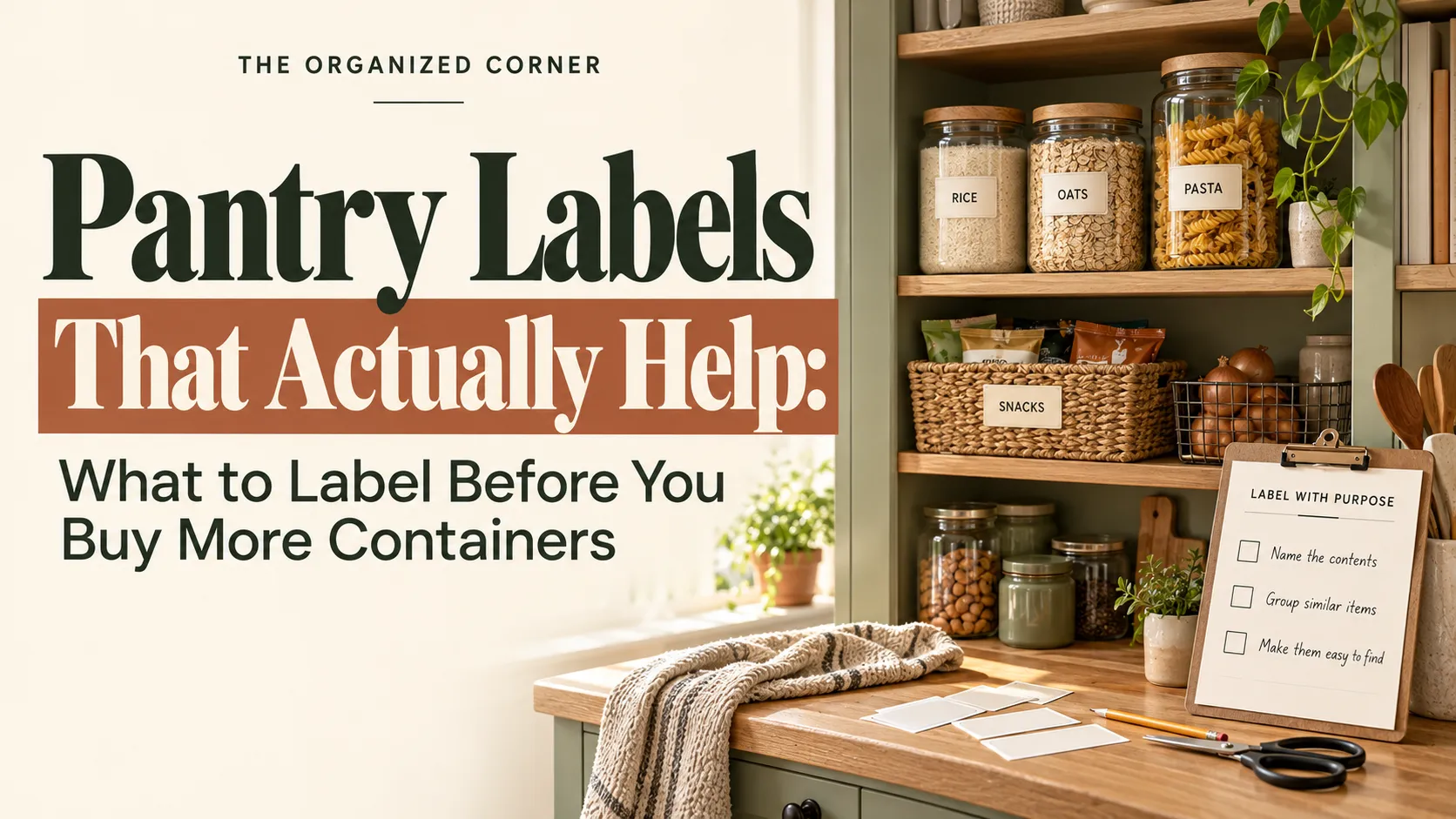
Pantry labels can make a kitchen easier to use.
But labels alone won’t fix a pantry where similar foods are scattered across several shelves, containers don’t fit the space, or nobody knows where things should go.
And you definitely don’t need to transfer every ingredient into a matching jar before your pantry can feel organized.
If you’re wondering how to label a pantry, start with function first.
Figure out what needs a clear home, group similar items together and then label the places or containers that genuinely make food easier to find and put away.
1. Organize Before You Start Labeling
Before printing or writing a single label, look at what is already in your pantry.
Group similar items together.
For example:
- pasta and grains
- breakfast foods
- baking ingredients
- snacks
- tinned foods
- tea and coffee
- herbs and spices
You may discover that some items don’t need containers at all.
A basket labelled Snacks can sometimes work better than transferring every individual snack into separate jars.
Labels should support your organization system—not create the system for you.
2. Label Categories When Individual Containers Aren’t Necessary
Not everything needs its own label.
If several packaged items belong together, label the basket or shelf instead.
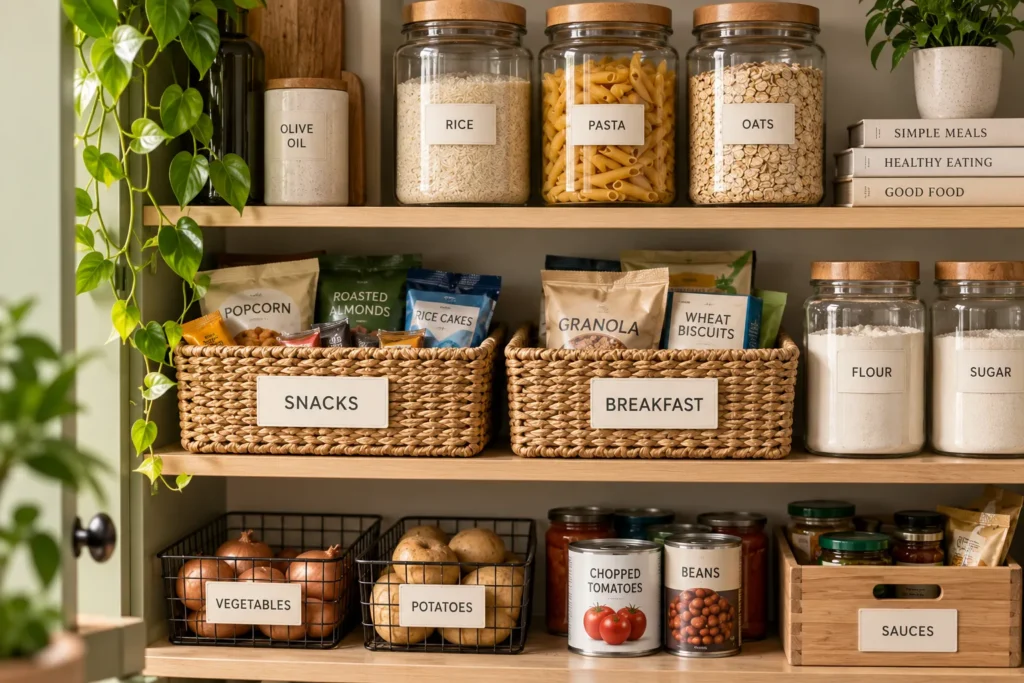
Examples include:
Snacks
Breakfast
Baking
Tea & Coffee
Sauces
Kids’ Snacks
This works especially well for things that stay in their original packaging.
It also makes putting groceries away easier because everyone can immediately see where the category belongs.
3. Label the Staples You Regularly Decant
Some pantry foods make sense in individual containers.
These are usually ingredients that you buy repeatedly and use often.
Good examples include:
- rice
- pasta
- oats
- flour
- sugar
- cereal
- lentils
- beans
Clear labels are particularly useful when two ingredients look similar.
You don’t want to discover halfway through cooking that the container you thought held plain flour actually contains something else.
Use straightforward names.
Rice is better than something decorative that takes longer to understand.
Your pantry should be easy to use at a glance.
4. Use the Names Your Household Actually Uses
Labels don’t need to sound impressive.
They need to make sense to the people using the kitchen.
If everyone calls something:
Pasta
label it Pasta.
You don’t need an overly specific category unless that distinction is genuinely useful.
Likewise, if you keep several snack types together, Snacks may be more practical than creating six different containers.
A good rule is:
If someone else in your home can understand the label immediately, it is probably specific enough.
5. Don’t Buy Containers Just Because You Have Labels
This is where pantry organization can become unnecessarily expensive.
It’s easy to see a beautiful shelf online and assume that every ingredient needs a new matching container.
It doesn’t.
Before buying anything, ask:
Will transferring this food make it easier to use?
Will I refill this container regularly?
Does the container actually fit my pantry?
Can I still see important information from the original packaging?
If the answer is no, keeping the original package inside a labelled basket may be the better system.
Your pantry should work better after organizing—not simply contain more containers.
6. Keep Important Food Information
Pantry organization labels are for identification.
They should not replace important information from the food’s original packaging.
If you decant something, make sure you still have access to information you may need, such as:
- expiry or best-before dates
- ingredients
- allergen information
- preparation instructions
- storage guidance
Your own Editable Pantry & Kitchen Labels product makes this same distinction: the labels are intended as organization/name labels and do not replace original ingredient, allergen, date or storage information.
7. Connect Your Labels to Your Pantry Inventory
Labels help you see where food belongs.
An inventory helps you see what you actually have.
Those two systems work well together.
If your pantry regularly ends up with three bags of rice but no pasta, use your labels alongside a pantry inventory system so you can check what’s available before shopping.
This creates a simple workflow:
Label where it belongs → track what you have → check before buying more.
That is much more useful than organizing purely for appearance.
8. Keep the System Easy to Update
Your pantry will change.
You may stop buying one ingredient, discover a new favourite or need to reorganize a shelf.
That’s why your labeling system shouldn’t feel permanent.
Leave room to adapt.
Editable labels can be useful because you’re not limited to a fixed list of pantry names.
The goal isn’t to create a pantry that stays identical forever.
It’s to create one where changing something doesn’t require starting again.
Pantry Labels Should Make Everyday Life Easier
A useful pantry label answers a simple question:
Where does this belong?
You don’t need hundreds of matching jars.
You don’t need every item decanted.
And you don’t need to label things simply because you can.
Start by grouping similar items.
Label categories where that makes sense.
Use individual labels for the staples you regularly transfer into containers.
Keep important food information.
Then connect the system to how you actually shop and cook.
A pantry that is easy to understand will usually stay organized longer than one designed only to look perfect.
Frequently Asked Questions
What should I label in my pantry?
Start with frequently used staples stored in containers, such as rice, pasta, oats and flour. You can also label baskets or shelves for broader categories such as snacks, baking supplies or breakfast foods.
Do pantry containers need labels if they are clear?
Clear containers still benefit from labels when ingredients look similar or when several people use the pantry. Labels can also make putting groceries away easier.
Should I put everything into matching pantry containers?
No. Only decant foods when doing so makes them easier to store or use. Packaged foods can often stay in their original packaging inside a labelled basket.
What information should I keep when decanting food?
Keep access to important original information such as expiry dates, ingredients, allergens, preparation instructions and storage guidance.
Join the conversation.